GHK-Cu 50mg: Reconstitution Math, Protocol Design & UAE Research Supply (2026)
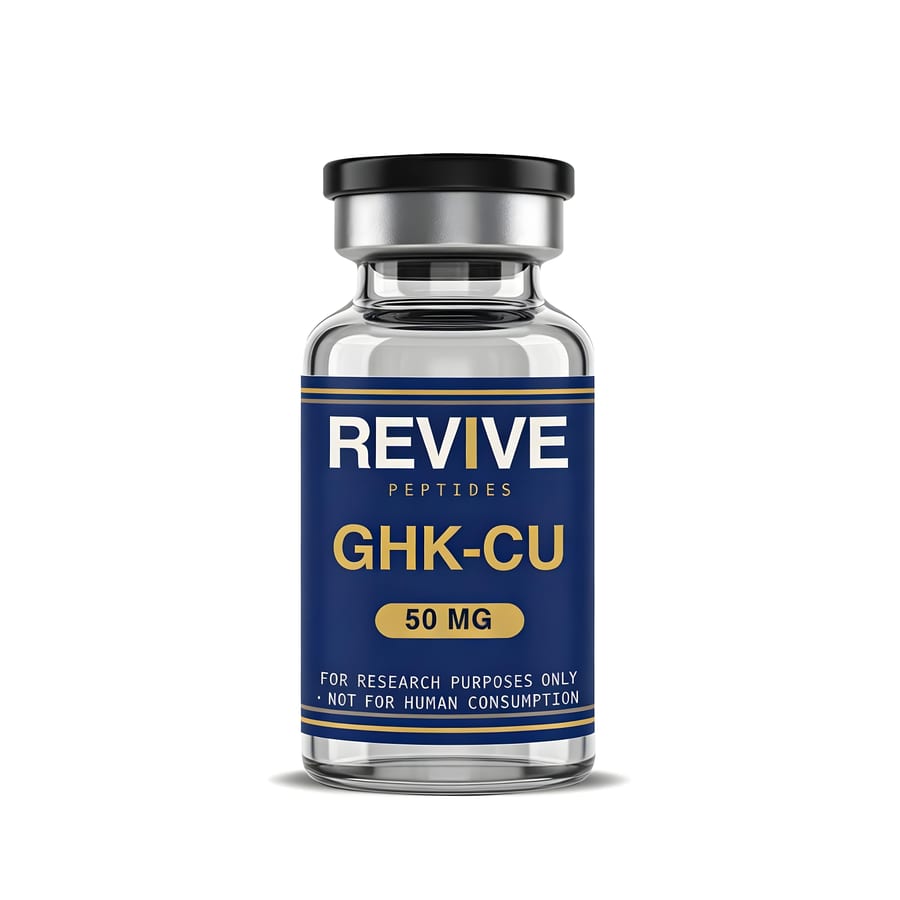
GHK-Cu sits at an unusual intersection in peptide research: it is one of the most-studied copper-binding tripeptides in the wound-healing and tissue-remodelling literature, and simultaneously one of the more frequently mis-reconstituted compounds in research settings — not because of anything exotic in the molecule, but because investigators reconstitute it inconsistently across sessions and lose track of their actual working concentration. The math — and how that math interacts with protocol duration, sampling frequency, and stability windows — is what separates a well-designed experiment from a wasted vial. If you want to buy GHK-Cu UAE and run a coherent research protocol, this is the guide to read before you order.
REVIVE LAB UAE supplies HPLC-verified, lot-COA, cold-chain dispatched GHK-Cu across all 7 emirates, with ghk-cu same day Dubai dispatch and next-day delivery to Abu Dhabi, Sharjah, RAK, Fujairah, Ajman and UAQ. The 50mg vial is in stock now at /buy-ghk-cu-uae/.
What Is GHK-Cu? Mechanism in 90 Seconds
GHK-Cu (glycine-histidine-lysine copper(II)) is a naturally occurring tripeptide first isolated from human plasma albumin. The copper(II) ion chelated to the GHK backbone is not incidental — it is central to the molecule's activity. Copper is required as a cofactor for lysyl oxidase, the enzyme that cross-links collagen and elastin fibres in the extracellular matrix. The tripeptide carrier increases local copper bioavailability far beyond what free ionic copper achieves, directing it to sites of tissue turnover rather than allowing systemic distribution.
The peer-reviewed literature on GHK-Cu clusters around three research domains, all underpinned by the references investigators cite most often:
- Collagen synthesis and extracellular matrix remodelling. Pickart and Margolina's 2018 review in Cosmetics (MDPI) documents GHK-Cu's ability to upregulate collagen I, collagen III, elastin, and glycosaminoglycans in fibroblast models, while simultaneously activating matrix metalloproteinases that clear damaged matrix components. The net effect is a remodelling phenotype — not simple synthesis stimulation. The review also notes that concentration matters: very high concentrations can attenuate or reverse the observed effects, making reconstitution precision a genuine experimental variable, not a technicality.
- DNA repair and broad gene-expression modulation. Campbell et al. (2012, BMC Genomics) profiled gene-expression changes associated with GHK, finding modulation across pathways governing DNA damage response, antioxidant defence, and ubiquitin-proteasome regulation. The breadth of the gene-expression signature identified in that work has been cited in subsequent GHK-Cu literature as evidence for the tripeptide's wide-ranging cellular effects beyond its canonical collagen-related activity.
- Wound healing and tissue remodelling in vivo. Pickart (2008, Advances in Wound Care) reviews GHK-Cu's wound-healing activity across animal models and in-vitro systems, covering nerve regeneration signalling, mast-cell recruitment, angiogenesis stimulation, and the tripeptide's role in orchestrating orderly tissue repair rather than scar-heavy fibrotic closure.
The practical implication for protocol design: GHK-Cu does not behave as a simple linear dose-response compound. Getting the reconstitution concentration right for your protocol has direct consequences for research quality.
Choosing Your Reconstitution Volume
REVIVE LAB UAE's GHK-Cu vial contains 50 mg of HPLC-verified copper chelate. The variable that shapes your protocol isn't vial size — it's how much bacteriostatic water you reconstitute with, since that determines your working concentration and how long the vial's material lasts across a study.
| Factor | Lower Reconstitution Volume (more concentrated) | Higher Reconstitution Volume (less concentrated) |
|---|---|---|
| Resulting concentration | Higher mg/mL | Lower mg/mL |
| Ideal protocol duration | Short (1–3 week study windows) | Extended (4–8+ week windows), lower per-draw concentration needed |
| Reconstituted-solution stability window | Same ~28-day reference window regardless of concentration | Same ~28-day reference window regardless of concentration |
| Total working volume | Lower — less solution to store | Higher — more solution to store and track |
The clearest use-case for a lower reconstitution volume (more concentrated solution): short protocol windows and lower-volume sampling designs, where a smaller total working volume is easier to manage. A higher reconstitution volume (more dilute solution) suits protocols that call for larger, more precisely measurable draws per sampling event. Either way, it's the same 50mg vial — REVIVE LAB UAE applies the same HPLC purity standard and lot-COA process regardless of how you choose to reconstitute it.
Reconstitution Math: Concentration Table
The most common research preparation error is an inconsistent bacteriostatic-water volume, producing a concentration that does not match the intended protocol. The table below covers four practical configurations for the 50mg vial. Reconstitute slowly — direct the bacteriostatic-water stream down the inner wall of the vial, never jet directly onto the lyophilized cake. Swirl gently; do not vortex. GHK-Cu is highly water-soluble and reconstitutes readily, yielding a characteristic blue-tinted solution (the copper chelation colour). A turbid or colourless solution indicates a quality issue — contact your supplier.
GHK-Cu 50mg Vial — Reconstitution Scenarios
| Bacteriostatic Water Added | Resulting Concentration |
|---|---|
| 2.5 mL | 20 mg/mL |
| 5.0 mL | 10 mg/mL |
| 10.0 mL | 5 mg/mL |
| 25.0 mL | 2 mg/mL |
This table describes reconstitution concentration math for laboratory handling only — REVIVE LAB UAE does not provide dosing, administration, or protocol-specific instructions for any product. Which concentration a given research protocol calls for is determined by that protocol's own design.
Buy GHK-Cu UAE — Order Now →
Protocol Design: Duration, Frequency and Stability Windows
The published literature on GHK-Cu does not anchor on a single standard research concentration the way that, for example, the tesamorelin lipodystrophy trials anchored on a fixed daily amount. Pickart and Margolina (2018) review a wide range of in-vitro and in-vivo concentrations that vary substantially by tissue type, model system, and endpoint. This is a feature, not a limitation — protocol flexibility in GHK-Cu research is high. What the literature consistently implies is that reconstitution concentration should be matched deliberately to protocol duration and sampling design, rather than reconstituted the same way by default every time:
- Reconstituted-solution stability window. Once GHK-Cu is dissolved in bacteriostatic water, the peptide solution should be stored at 2–8°C and used within a defined research window — general lyophilized-peptide practice and the stability considerations noted in the Pickart literature suggest a conservative 28-day working period, regardless of which concentration was chosen.
- Sampling intervals and measurement precision. Research designs calling for multiple small-volume sampling events per session fit most cleanly into a higher-concentration reconstitution (e.g., 20 mg/mL at 2.5 mL bacteriostatic water), where volumes per event are small and measurable. Lower-concentration reconstitutions produce larger volumes per sampling event that can be easier to handle precisely in some small-scale laboratory settings.
Endpoint-Matched Protocol Frameworks
The Campbell et al. (2012, BMC Genomics) gene-expression work used GHK to identify transcriptomic signatures across DNA repair, antioxidant, and proteasomal pathways. Protocols targeting these endpoints typically use acute exposures followed by harvest and qPCR or microarray analysis — short windows where a higher-concentration reconstitution is often the natural fit. Wound-closure and tissue-remodelling endpoints (aligned with Pickart 2008, Advances in Wound Care) use longer observation periods — with measurements at defined intervals — where a more dilute, larger-volume reconstitution can be more practical. Extracellular matrix and collagen endpoints (Pickart and Margolina 2018) sit between these extremes: typical fibroblast experiments run 5–14 days, making either reconstitution approach workable depending on study design.
For UAE-based investigators sourcing GHK-Cu in the UAE, REVIVE LAB UAE applies the same HPLC purity standard and lot-COA process to every vial — reconstitution volume is entirely a function of the research protocol, not the product itself.
Why Research-Grade Source Material Matters for GHK-Cu Specifically
The copper chelate in GHK-Cu is not a cosmetic feature of the molecule — it is mechanistically load-bearing. Pickart and Margolina (2018) explicitly note that the copper(II) coordination geometry is central to GHK-Cu's biological interactions with collagen synthesis machinery and DNA repair signalling. A GHK-Cu preparation that has lost its copper — through improper synthesis, degradation, contaminated starting material, or poor cold-chain handling — is effectively a structurally compromised, and potentially inactive, compound. The blue-tinted colour of properly reconstituted GHK-Cu is a useful qualitative indicator; it is not a substitute for verified lot-level data.
This is why REVIVE LAB UAE includes lot-COA with every GHK-Cu dispatch confirming both HPLC peptide purity and copper chelation. Every shipment is dispatched in cold-chain insulated packaging validated for UAE summer ambient temperatures — critical when ghk-cu Dubai 24h delivery means transit through courier networks that operate at 40°C+ in summer months. Vials ship lyophilized and sealed, in the most stable form, for maximum integrity on arrival.
Buy GHK-Cu Dubai — Order Now →
Where to Buy GHK-Cu in the UAE: Delivery Coverage
For researchers in the UAE, cold-chain logistics are as critical as peptide purity. A GHK-Cu vial that sits in an ambient-temperature courier vehicle for four hours in a Dubai summer has degraded before it reaches the research site. REVIVE LAB UAE runs refrigerated courier dispatch from Dubai, covering every emirate with defined delivery windows:
| Emirate / Key Areas | Delivery Window | Cash on Delivery | Cold-Chain |
|---|---|---|---|
| Dubai (Marina, JBR, Business Bay, DIFC, Downtown, Palm Jumeirah, JVC, Jumeirah, Emirates Hills) | Same-day, 4–8 hours | Yes | Yes |
| Abu Dhabi (Corniche, Yas Island, Saadiyat, Reem Island, Al Raha) | Next-day, 18–24 hours | Yes | Yes |
| Sharjah | Same-day / next-day, 8–18 hours | Yes | Yes |
| Ajman | Next-day, 18–24 hours | Yes | Yes |
| Ras Al Khaimah (RAK) | Next-day, 18–24 hours | Yes | Yes |
| Fujairah | Next-day, 24 hours | Yes | Yes |
| Umm Al Quwain (UAQ) | Next-day, 18–24 hours | Yes | Yes |
All shipments use plain unbranded outer cartons as standard. Payment is flexible: cash on delivery Dubai is accepted across all seven emirates, and USDT crypto pay via Binance Pay (TRC20 network) is available for researchers preferring digital settlement — with a 5% pre-pay discount applied automatically. This makes REVIVE LAB UAE one of the only peptides UAE suppliers combining full cold-chain logistics with dual payment options.
Researchers in Dubai who order before 4pm qualify for ghk-cu same day Dubai dispatch — vials typically arrive within 4–8 hours. The full product listing, lot-COA access and ordering process are at /buy-ghk-cu-uae/.
FAQ
Where can I buy GHK-Cu 50mg vials in the UAE with same-day delivery?
REVIVE LAB UAE stocks GHK-Cu 50mg vials with HPLC purity verification and lot-level COA confirming copper chelation. Same-day delivery applies to all Dubai orders placed before the daily cut-off — reaching Dubai Marina, JBR, Business Bay, DIFC, Downtown, Palm Jumeirah, JVC and Jumeirah within 4–8 hours. Abu Dhabi, Sharjah and all remaining emirates receive next-day delivery within 24 hours. Both cash on delivery and USDT crypto pay are accepted. Current stock and ordering at /buy-ghk-cu-uae/.
How does reconstitution volume change the concentration of a GHK-Cu 50mg vial?
The total peptide mass is fixed at 50 mg — only the concentration changes with how much bacteriostatic water is added. Reconstituted with 2.5 mL, the vial yields 20 mg/mL. With 5 mL it yields 10 mg/mL. With 10 mL it yields 5 mg/mL, and with 25 mL it yields 2 mg/mL. Researchers choose the reconstitution volume based on what concentration their protocol calls for — this is entirely a reconstitution-math question, not a question of different vial sizes. REVIVE LAB UAE stocks a single 50 mg GHK-Cu vial, confirmed ghk-cu in stock UAE.
Is GHK-Cu supplied as the pre-formed copper chelate, or do I need to add copper separately?
REVIVE LAB UAE's GHK-Cu vials are the pre-formed copper(II) chelate — the GHK tripeptide with the copper ion already coordinated at synthesis. No separate copper addition is required. The blue-tinted colour of the reconstituted solution is a visual indicator of intact chelation. Pickart and Margolina (2018, Cosmetics) emphasise that the copper coordination geometry is central to GHK-Cu's research activity profile, making the pre-chelated, COA-confirmed form the correct research-grade material. A colourless solution after reconstitution is a red flag indicating copper loss or product degradation — contact REVIVE LAB UAE for replacement.
Order GHK-Cu UAE Now →
- Pickart L, Margolina A. Regenerative and protective actions of the GHK-Cu peptide in the light of the new gene data. Cosmetics. 2018;5(2):29. doi:10.3390/cosmetics5020029
- Campbell JD, et al. Gene expression modulation and DNA-repair pathway analysis associated with GHK tripeptide. BMC Genomics. 2012.
- Pickart L. The human tri-peptide GHK-Cu and tissue remodeling: wound healing mechanisms and applications. Adv Wound Care. 2008.