Retatrutide Research Overview — Phase 2 Trial, Vial Math, and Storage
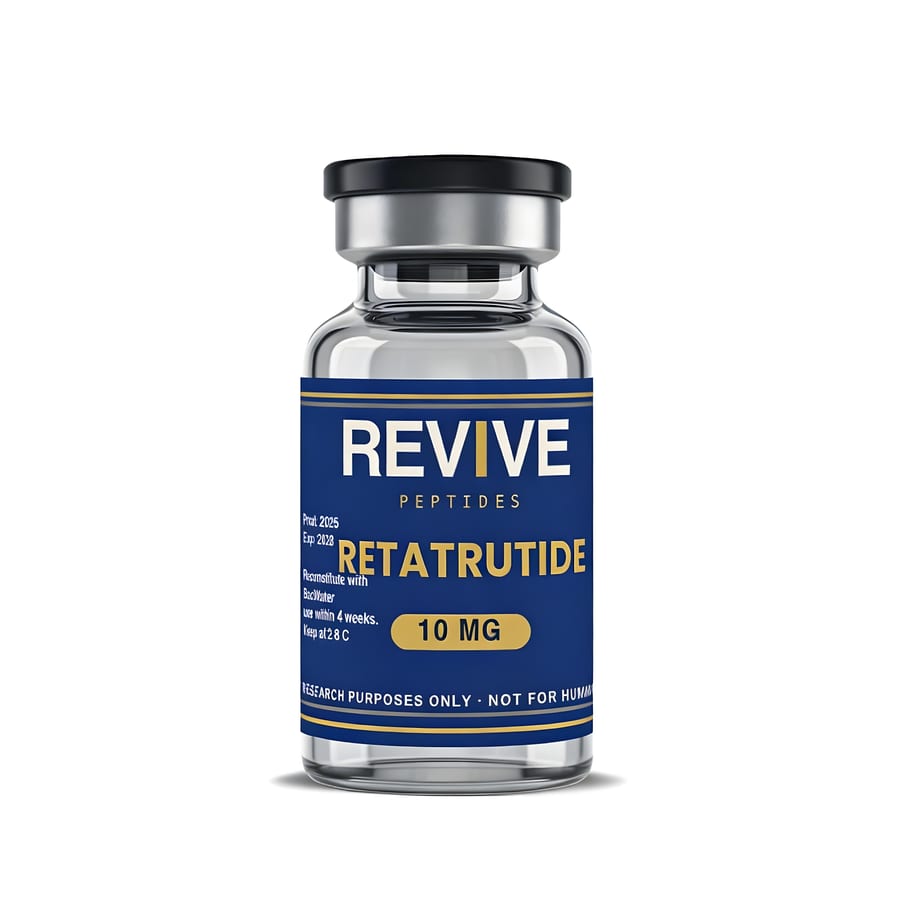
Eli Lilly's phase 2 trial (Jastreboff et al., NEJM 2023) is the most-cited published reference for retatrutide research — a triple GLP-1/GIP/glucagon-receptor agonist. This page covers the trial's design and results, mechanism, vial reconstitution math, and storage notes. It does not provide dosing or administration guidance — that determination sits entirely with the researcher's own institutional protocol.
1. The Jastreboff 2023 NEJM phase 2 trial
The retatrutide phase 2 trial published in New England Journal of Medicine in June 2023 is the most-cited reference for retatrutide research. The trial enrolled adults with obesity across several target-dose arms, using a gradual dose-escalation design over the first 12 weeks before reaching each arm's target — a standard approach in incretin-agonist trials to manage GI tolerability. REVIVE LAB UAE does not publish or provide the specific escalation schedule, dosing, or administration guidance for this or any compound.
The highest-dose arm achieved the headline 24.2% mean weight reduction at 48 weeks. GI side effects (nausea, vomiting, diarrhoea) were the dose-limiting factor reported for incretin agonists generally and triple agonists specifically, and the gradual escalation design in the trial was intended to manage that. This page reports the trial's published findings; it is not a schedule for researchers to follow.
2. Why retatrutide's mechanism differs from semaglutide's
Retatrutide is a triple agonist — it activates GLP-1, GIP, and the glucagon receptor in one molecule. Semaglutide hits only GLP-1. The glucagon-receptor arm of retatrutide is the new mechanism, and it's the one driving the unusually high weight reduction reported in the trial. The published literature also links it to greater early-course GI signal relative to semaglutide. Researchers comparing published data against semaglutide and tirzepatide trial results can find that comparison in our dedicated post.
4. Storage — lyophilised vs reconstituted
Unreconstituted retatrutide is highly stable. The lyophilised peptide tolerates room temperature for short windows (the entire UAE same-day delivery window from REVIVE LAB falls inside that envelope) and is rated stable for 24+ months refrigerated at 2-8 °C. Once reconstituted with bacteriostatic water, the stability window shortens considerably:
- Refrigerated (2-8 °C): 28 days is the commonly cited stability window for reconstituted GLP-1 / GIP / glucagon-receptor analogues. Most peptide chemistry references support this.
- Room temperature: Not recommended beyond brief handling — bac water provides bacteriostatic protection, not thermal stability.
- Freezer (-20 °C): Possible but freeze-thaw cycles damage peptide integrity. Avoid unless you're committing to a single thaw.
- Light exposure: Store vials in original boxes — peptides are photolabile.
For UAE researchers, the relevant detail is summer ambient: outdoor temperatures of 45 °C+ from June through September. REVIVE LAB ships in insulated packaging with cold-pack inserts, and we recommend transferring vials to refrigeration on arrival even though the lyophilised form is more thermally tolerant than the reconstituted form. See our dedicated post on UAE peptide cold-chain shipping for the full thermal-stability literature.
6. What the phase 2 trial did not test
The Jastreboff 2023 dataset is one phase 2 trial in adults with obesity. It is not a comprehensive safety database. Things the trial did not cover that researchers asking about retatrutide should know:
- Longer than 48 weeks. Phase 3 (the TRIUMPH program) is in progress as of this writing. Multi-year data is not yet published.
- Non-obese populations. Phase 2 enrolled BMI ≥30 (or ≥27 with comorbidities). Effects at lower BMI ranges are not characterised.
- Stack interactions. Co-administration with GHRH analogues like Tesamorelin (research interest for body recomp) is anecdotal at this stage. No controlled trial data exists for the combination.
- Dose discontinuation rebound. Several semaglutide datasets (STEP-4 trial extension) show substantial weight regain on cessation. Retatrutide discontinuation has not been formally studied at the published level.
7. UAE supply context — why the vial size matters here
UAE researchers running comparison protocols against compounded semaglutide face a specific supply problem: most compounded GLP-1 in the regional grey market is reconstituted at variable concentrations, with no batch-level COA. Retatrutide from REVIVE LAB UAE arrives lyophilised with HPLC-verified mass and an accompanying lot-level certificate of analysis — meaning the dose-response data above can be reproduced with confidence.
Vial size choice (5 mg vs 10 mg) is entirely the researcher's own determination based on their own research plan. Both are available as retatrutide UAE with same-day Dubai dispatch and 24-hour delivery across the seven emirates.
8. The summary
- Retatrutide research is anchored by Jastreboff 2023 NEJM phase 2 — a triple GLP-1/GIP/glucagon-receptor agonist trial using a gradual dose-escalation design over 48 weeks.
- REVIVE LAB UAE does not publish or provide the specific escalation schedule, dosing, or administration guidance for this or any compound.
- 5 mg vial + 2 mL bac water = 2.5 mg/mL; 10 mg vial + 2 mL = 5 mg/mL (concentration math only).
- Refrigerate reconstituted vials at 2-8 °C, use within 28 days. Avoid freeze-thaw.
- UAE supply: REVIVE LAB UAE ships HPLC-verified retatrutide in both vial sizes with lot-level COA, same-day dispatch before 4 PM, 24-hour delivery.
References
- Jastreboff AM, Kaplan LM, Frías JP, et al. Triple-Hormone-Receptor Agonist Retatrutide for Obesity — A Phase 2 Trial. N Engl J Med. 2023;389(6):514-526. PubMed
- Rosenstock J, Frias J, Jastreboff AM, et al. Retatrutide, a GIP, GLP-1 and glucagon receptor agonist, for people with type 2 diabetes: a randomised, double-blind, placebo and active-controlled, parallel-group, phase 2 trial. Lancet. 2023;402(10401):529-544. PubMed
- Sanyal AJ, Kaplan LM, Frias JP, et al. Triple hormone receptor agonist retatrutide for metabolic dysfunction-associated steatotic liver disease: a randomized phase 2a trial. Nat Med. 2024;30(7):2037-2048. PubMed
- Wilding JPH, Batterham RL, Calanna S, et al. Once-Weekly Semaglutide in Adults with Overweight or Obesity (STEP-1). N Engl J Med. 2021;384(11):989-1002. PubMed
- Frias JP, Davies MJ, Rosenstock J, et al. Tirzepatide versus Semaglutide Once Weekly in Patients with Type 2 Diabetes (SURPASS-2). N Engl J Med. 2021;385(6):503-515. PubMed