Retatrutide Taper & Stop Protocol — UAE Researcher Guide
Why "Just Stop" Is a Research Design Error
Most retatrutide research literature focuses heavily on initiation — ramp-up schedules, receptor agonism kinetics, the novel GIP/GLP-1/glucagon triple mechanism that separates retatrutide from single- and dual-agonist predecessors. The exit strategy receives far less attention, and that gap produces noisy data. If you are designing a retatrutide research protocol, the taper phase is not optional administrative tidying: it is a distinct experimental phase with its own observable endpoints and its own confound risks if mishandled.
The underlying issue is pharmacodynamic re-equilibration. Retatrutide engages three receptor axes simultaneously — GLP-1R, GIPR, and glucagon receptor. Each axis carries different baseline signalling tone and will upregulate at a different rate after sustained exogenous agonism is withdrawn. When the compound is removed abruptly, the receptor landscape is not restored to pre-study baseline instantaneously. It is transiently altered — and the trajectory of that re-equilibration is itself a scientifically meaningful signal. A structured taper allows you to observe those kinetics; an abrupt stop collapses them into noise.
In the Jastreboff et al. 2023 NEJM phase 2 trial — the foundational published dataset most UAE researchers will reference — subjects in higher-dose cohorts showed measurably different post-treatment trajectories compared to lower-dose cohorts during the follow-up period. Those between-cohort differences in the post-cessation window are among the most informative data points in the entire dataset, and they are only interpretable if the cessation itself was controlled. Researchers who end protocols without a documented taper cannot cleanly attribute post-cessation observations to dose, duration, or abruptness of cessation. That ambiguity costs you the follow-up data.
What the Phase 2 Trial Tells Us About the Post-Cessation Window
The Jastreboff et al. 2023 NEJM phase 2 study enrolled subjects across multiple dose cohorts, with a 24-week active treatment phase followed by a structured post-treatment follow-up period. The follow-up data revealed that the rate of trajectory change post-cessation was both dose-dependent and non-linear: higher-dose groups showed steeper early post-cessation dynamics, with the most pronounced changes concentrated in the first four to eight weeks off compound.
This has a direct implication for research design: if your protocol terminates on a fixed calendar date with abrupt cessation, any observations made in the subsequent eight to twelve weeks carry a large uncontrolled variable — namely, the abruptness of the drop. A planned, symmetric taper converts that variable into a controlled experimental condition, allowing post-cessation observations to be cleanly attributed to the absence of compound rather than to the shock of withdrawal.
The Eli Lilly TRIUMPH phase 3 programme, expanding on the phase 2 dose-ranging findings, incorporated structured cessation monitoring as a first-class element of study design rather than an afterthought. Interim readouts from the TRIUMPH trials reinforce the view that the post-cessation observation window is not a grace period — it is a primary data-generating phase that rewards deliberate design. Researchers in Dubai and across the UAE who are running multi-month retatrutide protocols should treat the taper and stop phase with the same rigour they apply to induction.
Research Design Considerations for the Titration and Taper Phases
Published phase 2 literature indicates that the plateau, mid-range, and lower dose bands studied each carry a distinct response signature — they are separable pharmacological bands, not arbitrary increments. A well-designed taper descends through the same bands the induction phase ascended through, in reverse, at a comparable step rate, creating a within-study mirror structure that is directly analytically comparable to the induction phase.
The symmetry here is deliberate: a taper that descends at the same rate the induction phase ascended makes the taper phase a true intra-study control, with the directionality of receptor modulation as the isolatable variable. Researchers who use asymmetric tapers (slower or faster than the induction rate) introduce a confound that is difficult to model out retrospectively. REVIVE LAB UAE does not provide dosing, titration, or cycling guidance for any compound — the number of steps, the dose at each step, and the duration of each step are determinations that sit entirely with the researcher's own institutional protocol.
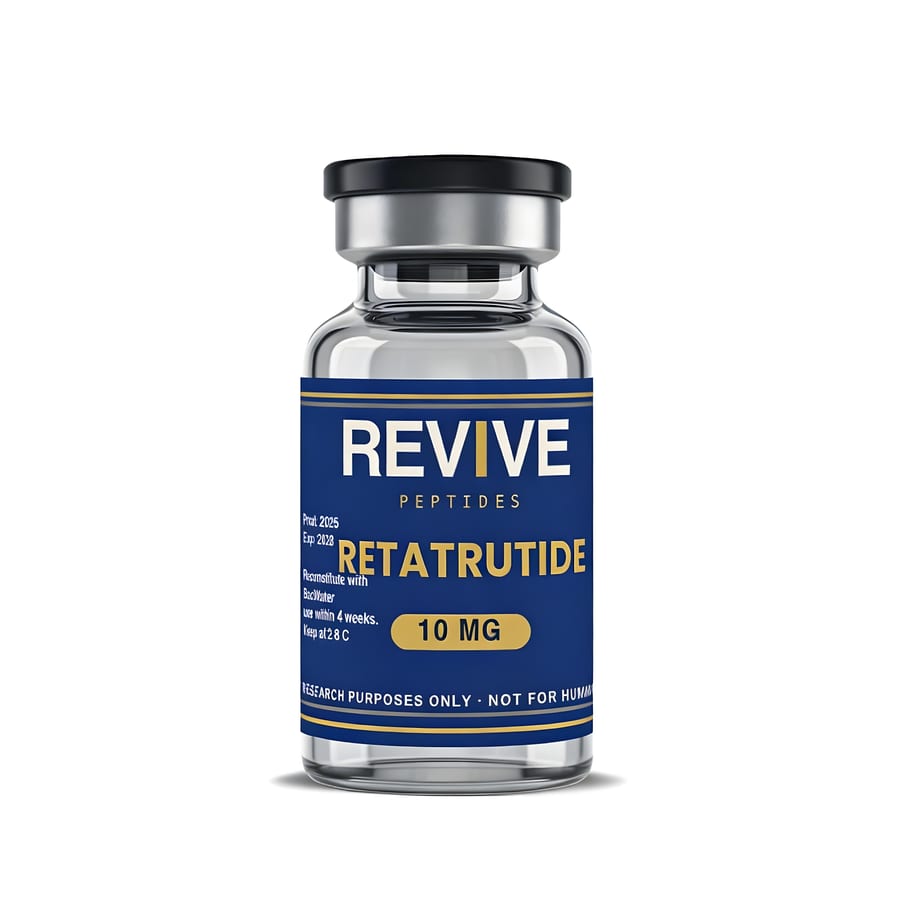
A practical note on vial sizing for UAE researchers: REVIVE LAB UAE carries retatrutide in 5mg and 10mg lyophilised vials. The 10mg vial offers more total material per reconstitution event, which can reduce the number of reconstitution cycles over the course of a longer study. The 5mg vial is a better fit where a smaller total volume is needed, since reconstituted lyophilised peptides have a finite stability window under refrigerated storage — researchers should plan reconstitution timing to minimise dwell time between preparation and use, per their own institutional storage protocol.
5mg & 10mg lyophilised vials available now. Order before 4 PM GST for same-day delivery across Dubai, Business Bay, Marina, JBR, and Palm Jumeirah.
Buy Retatrutide UAE — 24h Delivery from REVIVE LAB UAE
Research Design Framework for the Concluding Phase
The taper is a dose schedule; the stop protocol is the broader research framework that determines what you observe, when you observe it, and how you contextualise the post-cessation data. Both components need to be designed before administration begins — not reconstructed from partial records after the final dose. REVIVE LAB UAE does not provide dosing, cycling, or administration guidance for any compound — that determination sits entirely with the researcher's own institutional protocol.
Designing the Descent
In the phase 2 dataset, each dose band studied had a distinct response profile — which means re-entering a lower band on the way down is not simply "reducing exposure," but re-entering a pharmacologically meaningful range where the receptor system is being asked to adapt in the downward direction. A well-designed descent plans a dwell period at each step before the next reduction, long enough to capture the initial rebound signal before it is masked by the subsequent step, giving a clean block of data at that step on the taper side to pair against the equivalent block from induction. The number of steps, the size of each step, and the dwell time at each step are determinations that sit entirely with the researcher's own institutional protocol.
Approaching the Lower Bound
The final planned reduction brings the research dose to whatever minimum level a given protocol has defined as meaningful, based on the published dataset's observed range of pharmacological signal. At this stage, the receptor system is approaching its endogenous baseline but has not yet reached it — the compound is still present and active, but the margin above noise narrows. This stage is particularly valuable for capturing the differential between the last two steps on your tracked endpoints, since this is the last within-treatment comparison available. An endpoint that shows no step-wise difference at this stage is either insensitive to dose in this range or has reached a floor effect.
Defining Cessation
Cessation is the point at which no further compound is introduced and the post-cessation observation window formally opens. Because slower-responding endpoints can take considerably longer to stabilise than faster-responding ones, protocols that end observation too soon after the final dose commonly report incomplete datasets in subsequent publications, since those slower endpoints have not yet stabilised and cannot be cleanly interpreted. The appropriate observation duration and interim measurement points are a matter for the researcher's own protocol design, informed by which endpoints are being tracked.
Post-Cessation Observations: What to Track and When
Post-cessation, the research question fundamentally changes. You are no longer asking what retatrutide does at a given dose. You are asking how the system behaves in the absence of a compound it has been exposed to for six months or more. These are structurally different questions, and conflating them — by treating the post-cessation phase as a passive wind-down rather than an active observation phase — is one of the most common analysis errors in published peptide research.
Published follow-up data suggests post-cessation dynamics unfold across several qualitative phases rather than as a single event: an early phase, shortly after the final dose, when circulating compound is declining most rapidly and the earliest divergence from plateau becomes visible; a mid phase during which rebound trajectories tend to peak as receptor re-sensitisation is underway; and a later phase in which most tracked endpoints gradually approach pre-study baseline, though the rate is endpoint-dependent. Confirmatory, near-baseline readings typically come later still.
The key finding from the post-treatment follow-up in Jastreboff et al. 2023 NEJM — and reinforced by TRIUMPH phase 3 interim data — is that post-cessation dynamics are not uniform across endpoints. Some markers return to near-baseline considerably faster than others. This heterogeneity is not a problem to be managed: it is scientifically informative. It tells you which physiological systems were most durably modulated by sustained retatrutide exposure and which were transiently engaged. Capturing both the fast and slow components requires measurement points that are pre-committed before the study begins and spaced appropriately across the observation window — REVIVE LAB UAE does not specify what that spacing should be; it is a matter for the researcher's own protocol design. Designing that schedule after observing partial data is a form of p-hacking that compounds across endpoint choices.
UAE-Specific Logistics: Keeping the Taper Phase Uninterrupted in Dubai
For researchers based in the UAE — whether operating from a Business Bay research facility, a JBR private lab, a Sharjah clinical research organisation, or an Abu Dhabi academic institution — the logistics of maintaining a clean taper phase are primarily a supply chain question. Running out of material partway through a multi-step descent is one of the most common and most avoidable causes of protocol contamination in multi-month UAE peptide research programmes. An unplanned supply gap mid-taper introduces an uncontrolled cessation event at an arbitrary point in the descent, which is analytically equivalent to no taper at all.
The practical recommendation: before the descent phase begins, calculate your total remaining vial requirement through to the final planned step, and place a single consolidated order. Do not plan to reorder mid-taper. REVIVE LAB UAE maintains consistent inventory of retatrutide 5mg and 10mg vials with no pre-order requirement — but placing the consolidated order at the start of the descent phase eliminates any timing risk entirely.
REVIVE LAB UAE dispatches same-day for orders placed before 4 PM GST, with 24h delivery coverage across Dubai (DXB corridor, Marina, JBR, Business Bay, Palm Jumeirah), Abu Dhabi, and Sharjah. Cold-chain is maintained throughout dispatch; lyophilised vials arrive ready for refrigerated storage at 2–8°C. For researchers with tight delivery windows — particularly those running weekly dosing schedules where a Wednesday order needs to arrive by Thursday — the same-day DXB delivery window at REVIVE LAB UAE is reliable enough to factor into your protocol calendar.
Payment is available via cash on delivery across Dubai and the UAE, which removes payment processing friction for researchers ordering on short notice. Binance Pay (USDT TRC20) accepts payment with a 5% pre-pay discount — the better option if you are consolidating a multi-vial taper-phase order and want to reduce total cost. Both options are available at checkout on revivelab.ae with no minimum order.
Protocol Documentation: What to Record Through the Taper and Stop Phase
A retatrutide taper and stop protocol is only as reproducible as the records that accompany it. UAE researchers running multi-week studies — whether at a Marina-area private research practice, a DIFC-adjacent CRO, a Sharjah biomedical research centre, or an Abu Dhabi university lab — should maintain a protocol record that captures the following fields for the taper and cessation phases specifically:
- Vial lot numbers and procurement source: Record REVIVE LAB UAE lot numbers for every order placed during the taper phase. This allows batch-level variables to be identified if taper-phase results deviate unexpectedly from induction-phase patterns.
- Reconstitution log: Date, bacteriostatic water volume added, resulting concentration per vial, and storage temperature for every reconstitution event. This log establishes the full post-reconstitution age of each preparation at time of use, which matters given the finite stability window of reconstituted lyophilised peptides.
- Dose administration log: Date, dose in mg, and time for every administration. For the taper phase, flag any protocol deviation — delayed dose, missed week, early cessation — as these directly affect the calculation of the post-cessation observation window start date.
- Pre-specified endpoint schedule: The post-cessation measurement calendar must be defined before the first taper dose, not after the final dose. Retrospectively selecting which time points to report based on observed data is a confound that affects the entire post-cessation analysis.
- Post-cessation observation log: Index all post-cessation measurements against the final dose date — not against the nominal "end of protocol" date — to ensure the timing is anchored to pharmacological reality rather than administrative convenience.
Researchers at UAE institutions with existing SOPs will slot these fields into established frameworks. Independent researchers benefit most from adopting a standardised template at protocol start: retrofitting documentation to a completed or partially completed protocol is a well-documented source of errors in peptide research outputs, and is particularly problematic for taper-phase data where the timing of each dose step is analytically significant.
FAQ
Where can I buy retatrutide in the UAE with same-day delivery?
REVIVE LAB UAE stocks retatrutide 5mg and 10mg lyophilised vials and dispatches same-day for orders placed before 4 PM GST. Delivery covers Dubai (Marina, Business Bay, JBR, Palm Jumeirah, DXB corridor), Abu Dhabi, and Sharjah within 24 hours. There is no pre-order requirement — retatrutide is in stock for immediate dispatch. Order directly at revivelab.ae/buy-retatrutide-uae/. Cash on delivery and Binance Pay (USDT TRC20) are both accepted.
What retatrutide vial sizes does REVIVE LAB UAE stock?
REVIVE LAB UAE carries retatrutide in 5mg and 10mg lyophilised vials. REVIVE LAB UAE does not provide dosing, titration, or administration guidance for any compound — vial size selection is a matter for the researcher's own institutional protocol and study design.
Does REVIVE LAB UAE offer discreet packaging and cash on delivery for retatrutide orders in Dubai?
Yes. Every REVIVE LAB UAE order — single vial or multi-vial — ships in plain, unmarked outer packaging with no product name, brand logo, or content description visible on the exterior. Cash on delivery is standard across Dubai and the wider UAE. Binance Pay (USDT TRC20) is also accepted with a 5% pre-pay discount applied automatically at checkout. Both options are available on revivelab.ae with no minimum order value.
- Jastreboff AM, Kaplan LM, Friás JP, et al. Triple–Hormone-Receptor Agonist Retatrutide for Obesity — A Phase 2 Trial. New England Journal of Medicine. 2023;389(6):514–526. doi:10.1056/NEJMoa2301972
- Eli Lilly and Company. TRIUMPH Phase 3 Clinical Programme — Retatrutide (LY3437943) Interim Trial Readouts. ClinicalTrials.gov identifiers NCT05929066 and NCT05564897. Data on file; accessed 2026.
5mg & 10mg lyophilised vials in stock at REVIVE LAB UAE. Discreet packaging, cash on delivery, and 24h delivery across Dubai, Abu Dhabi, and Sharjah. No pre-order. No waitlist.
Buy Retatrutide Dubai — Order Now at REVIVE LAB UAE