Retatrutide Injection Site Research — What UAE Labs Need to Know
Why Injection Site Is a Meaningful Research Variable for Retatrutide
Retatrutide — the triple GLP-1/GIP/glucagon receptor agonist developed by Eli Lilly — is one of the most intensively studied peptide compounds in current metabolic and body composition research. Its mechanism engages three distinct receptor pathways simultaneously, and its once-weekly subcutaneous administration makes depot selection an ongoing protocol decision, not a one-time choice. Every week of a research run is another data point where injection site is either a controlled constant or an uncontrolled variable.
Researchers ordering retatrutide in the UAE — whether operating from private labs in Business Bay, academic research units near Dubai Knowledge Park, or research facilities in JBR and the Marina — are increasingly asking how injection site selection should be reflected in protocol design. REVIVE LAB UAE does not answer that question with specific guidance: site selection, rotation, and technique are determinations that sit entirely with the researcher's own institutional protocol and ethics-approved study design.
This article looks at how published retatrutide literature treats injection site as a research-design variable in the abstract, and at the UAE-specific logistics — climate, cold-chain, sourcing — that surround, but are independent of, that decision. Nothing here constitutes medical advice, administration guidance, or a site-selection recommendation. All framing is for laboratory and pre-clinical research-context discussion only.
Depot Variability as a Research Design Factor
Subcutaneous injection research relies on the adipose tissue layer beneath the skin as the delivery depot. The architecture of that layer — depth, vascularisation, regional blood flow, and thermal sensitivity — varies between different body sites. For peptides administered on a repeating schedule over multi-week protocols, these differences can compound across administrations and become a meaningful confound if site selection is not systematically controlled within the protocol.
Published subcutaneous peptide research addresses this by treating site selection, and any rotation between sites, as a pre-specified protocol variable rather than an ad hoc choice made administration-to-administration. REVIVE LAB UAE does not specify which sites to use, how many rotation zones to define, or how frequently to rotate — those are determinations that belong entirely to the researcher's own institutional protocol, informed by their study's ethics approval and the anatomy of their specific research subjects.
What the Published Retatrutide Data Says About Site Selection
The Jastreboff et al. 2023 NEJM study — the foundational published phase 2 dataset for retatrutide — enrolled 338 subjects across multiple escalating dose cohorts and used once-weekly subcutaneous administration, with a single reference site defined in the trial protocol and a rotation scheme specified for repeated administrations. This anchors the entire published efficacy and tolerability dataset for retatrutide to a specific, protocol-defined subcutaneous delivery approach. Any deviation from the trial's own site methodology in subsequent research introduces a variable that the published literature does not directly control for.
The Eli Lilly TRIUMPH phase 3 program — the ongoing pivotal registration trials — subsequently expanded the allowable site list to include additional rotation options, a standard step in long-duration trials to prevent lipohypertrophy at any single depot over extended protocol windows. The practical implication for researchers is that Lilly's own phase 3 methodology treats appropriately rotated alternate sites as pharmacologically comparable for trial purposes, even though the phase 2 study used a narrower reference-site definition.
For UAE research labs designing their own protocols around published retatrutide data, the general principle is to define a reference site and any rotation scheme before the study begins, and to hold that definition constant within each dose step so that dose-response observations are not confounded by within-step site switching. REVIVE LAB UAE does not specify what that reference site or rotation scheme should be — that determination sits entirely with the researcher's own institutional protocol.
Factors Researchers Weigh in Site Selection
Discussed in the abstract, and without prescribing any of these choices, researchers designing a retatrutide protocol typically weigh a handful of variables when selecting a reference site and any rotation scheme: precedent set by the published trial data they intend to compare against; how much regional blood flow at a candidate site varies with activity level and ambient temperature; how large a rotation surface a candidate site offers relative to protocol length; and how easily local tissue reactions can be observed and documented at that site. None of these factors dictates a single correct choice — they are inputs to a decision that REVIVE LAB UAE leaves entirely to the researcher's own institutional protocol.
Same-day dispatch before 4 PM Dubai time. Discreet packaging. Cash on delivery across DXB, Abu Dhabi & Sharjah. Buy Retatrutide UAE — Same-Day Dubai Dispatch from REVIVE LAB UAE
UAE Climate Factors Relevant to Site-Related Research Design
This is the section that Western-published trial data simply cannot address, and it matters specifically for researchers operating across Dubai, Abu Dhabi, Sharjah, and the wider UAE. The environmental baseline in UAE research conditions — particularly from June through September — is categorically different from that of North American or European trial sites where the retatrutide phase 2 and phase 3 data was collected.
Ambient Heat and Subcutaneous Vascular Response
In sustained ambient temperatures above 38–40°C, which are routine in UAE summer conditions, the body's thermoregulatory response drives significant peripheral vasodilation, and different subcutaneous depots are affected to different degrees depending on their relative exposure and vascularity. In a research context, this means that ambient temperature at the time of administration is itself a variable that can affect absorption-onset variability, independent of which specific site a protocol uses. Researchers designing site-related comparison protocols during UAE summer months should document ambient temperature at the time of each administration as a protocol variable — a requirement rarely seen in temperate-climate trial designs, but essential here for data interpretability. How to respond to that variable in terms of site choice is a matter for the researcher's own institutional protocol; REVIVE LAB UAE does not recommend a specific site or seasonal rotation scheme.
Cold-Chain Integrity from Warehouse to Lab Bench
Retatrutide research vials from REVIVE LAB UAE are stored and dispatched under cold-chain conditions (2–8°C). Researchers across Palm Jumeirah, JBR, the Marina, and Abu Dhabi should be rigorous about maintaining that chain through final receipt. In UAE summer conditions, vehicle interiors and courier transit environments can exceed 50°C within minutes of sun exposure — sufficient to compromise reconstituted peptide integrity even in short transit windows. REVIVE LAB UAE dispatches with insulated cold packs; researchers should ensure collection or receipt happens promptly and that vials are refrigerated within the target window. This is a pre-protocol concern that is entirely independent of injection-site selection, but it directly affects the quality of the compound being administered.
Ramadan and Fasting-State Protocol Windows in UAE Research
UAE-based researchers designing metabolic observation protocols may need to account for fasting-state periods — particularly during Ramadan — which affect a significant proportion of research subjects in this region. Fasting state is a documented variable in GLP-1 receptor agonist research contexts, with post-prandial versus fasted administration timing affecting observable outcome measures. When fasting-state considerations are layered onto any site-rotation scheme a study is using, researchers introduce two concurrent variables that must be systematically separated in the analysis design. The cleaner methodological approach, as with any concurrent variable, is to hold one constant while isolating the other — the specifics of how to do that for a given protocol are a matter for the researcher's own institutional design.
Vial Selection for UAE Research Protocols
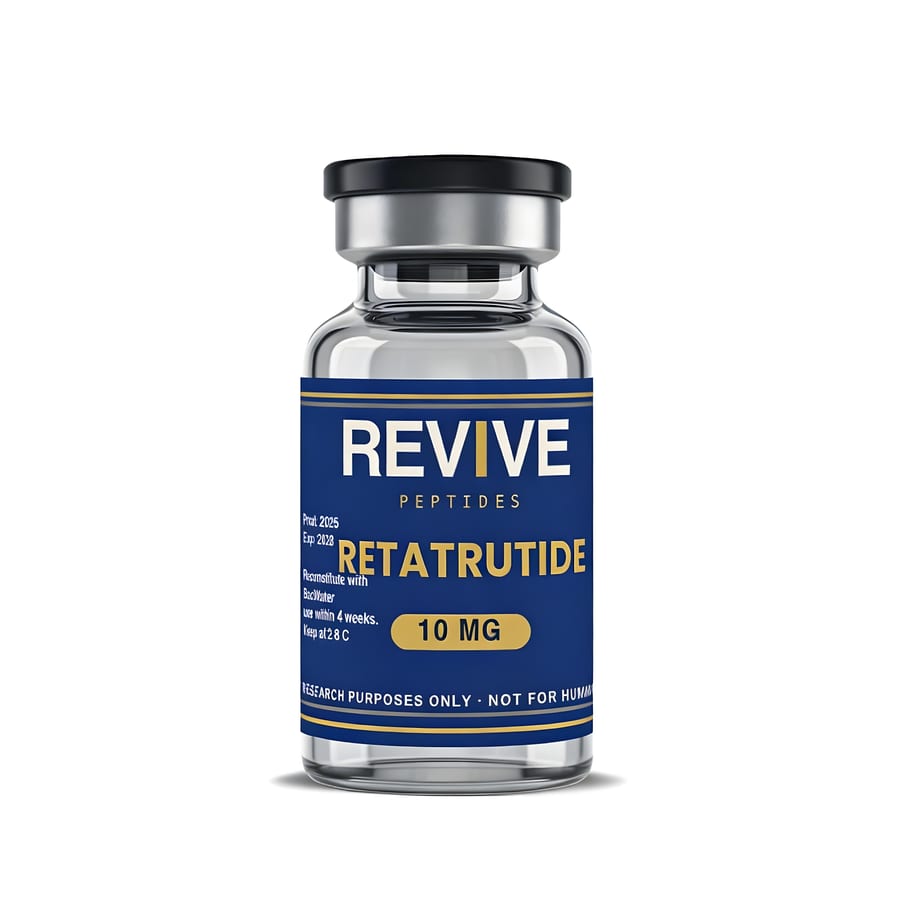
REVIVE LAB UAE carries retatrutide in 5mg and 10mg lyophilised vials. Vial size selection is generally a function of protocol duration, reconstitution volume, and how many administrations a researcher plans to draw from a single reconstituted vial before its post-reconstitution stability window closes — not a fixed prescription. REVIVE LAB UAE does not provide dosing or titration guidance for any compound; the researcher's own institutional protocol determines which vial size best matches a given study design.
A general planning note: researchers should calculate total vial requirement for a protocol's full planned duration before the study begins, factoring in the number of administrations expected per reconstituted vial and the finite stability window of reconstituted lyophilised peptide once bacteriostatic water has been added, rather than purchasing vials ad hoc as the study progresses.
Site Rotation as a Research Design Concept for Extended UAE Research Windows
Protocols extending over multiple weeks — common in body composition, metabolic marker, and receptor sensitivity research using retatrutide — often require a systematic site rotation approach to prevent lipohypertrophy at any single depot. Lipohypertrophy at an injection site is both a confounding variable (altered local tissue architecture changes depot behaviour) and a protocol observation endpoint that needs to be recorded if it occurs.
REVIVE LAB UAE does not define how many rotation zones to use, where they should be located, or how long the recovery window between uses of the same zone should be — these are determinations that sit entirely with the researcher's own institutional protocol, informed by their ethics-approved study design and the anatomy of their research subjects. What published literature does support is the general principle: pre-specifying a rotation scheme before the study begins, and documenting each administration against that scheme with a timestamp and any local tissue observations (erythema, induration, palpable nodule formation), gives both a safety log and methodological data if site-specific differences become relevant to the research question. Researchers at UAE lab facilities — whether in Dubai Science Park, Masdar City in Abu Dhabi, or private research operations in Sharjah and Ras Al Khaimah — running extended protocols should maintain this record consistently for the full study duration.
Sourcing Research-Grade Retatrutide in UAE: What Actually Matters
For injection-site comparison research to produce interpretable data, the compound itself must be consistent across administrations. Variability at the formulation level — purity drift, concentration inconsistency, or degradation from poor cold-chain management — will confound any site-to-site observation regardless of how carefully the injection protocol is designed. This is why sourcing from a UAE-based supplier with in-country stock and a verifiable cold chain matters more than it might seem on the surface.
When you order retatrutide in Dubai from REVIVE LAB UAE, the supply chain is shorter and more controlled than overseas-shipped alternatives. Vials are held in UAE cold storage and dispatched with insulated packaging — they are not clearing customs, sitting in freight holds, or transiting through multiple ambient-temperature handoffs before reaching your lab bench. For researchers in time-sensitive protocol windows across JBR, Business Bay, the Marina, and Palm Jumeirah, retatrutide same-day delivery from REVIVE LAB UAE means a protocol gap from a delayed order is not a research-disrupting event.
Key sourcing facts for UAE researchers:
- Retatrutide available in 5mg and 10mg lyophilised research vials — requires reconstitution with bacteriostatic water prior to use, consistent with research-standard handling
- Retatrutide in stock UAE — no overseas shipping delays; domestic warehouse dispatch
- Same-day delivery across Dubai for orders placed before 4 PM (JBR, Marina, Business Bay, DIFC, Downtown, Palm Jumeirah, DXB airport corridor)
- Retatrutide 24h delivery Dubai and wider UAE including Abu Dhabi and Sharjah
- Retatrutide discreet packaging UAE — outer box carries no identifying product labels
- Retatrutide cash on delivery Dubai — available across Dubai, Abu Dhabi and Sharjah
- WhatsApp order support for vial selection queries and protocol-level stock planning
One technical point that researchers comparing peptides UAE suppliers should verify: lyophilised (freeze-dried) vials are the correct format for retatrutide research use. Pre-dissolved liquid formulations are significantly less stable — particularly under UAE ambient temperature conditions — and introduce concentration uncertainty that undermines the precision a research protocol requires. All REVIVE LAB UAE retatrutide vials are lyophilised powder format.
FAQ
Which injection site is used in published retatrutide research?
Published retatrutide trials defined a specific reference site and a systematic rotation scheme as part of their protocol design — a standard practice in subcutaneous peptide research to distribute repeated administrations across the available research area and manage lipohypertrophy risk. REVIVE LAB UAE does not provide guidance on which injection site to use or how to rotate — that determination sits entirely with the researcher's own institutional protocol, informed by their study's ethics-approved design.
Where can I order retatrutide vials with same-day delivery in Dubai?
REVIVE LAB UAE (revivelab.ae) stocks retatrutide 5mg and 10mg vials for research use, with same-day dispatch for orders placed before 4 PM Dubai time. Delivery covers all major Dubai districts — JBR, Marina, Business Bay, DIFC, Palm Jumeirah, Downtown, and the DXB corridor — plus 24h courier to Abu Dhabi and Sharjah. Discreet packaging and cash on delivery are both available. Visit /buy-retatrutide-uae/ to place an order or contact via WhatsApp for bulk protocol-level orders.
What vial strengths of retatrutide does REVIVE LAB UAE carry for research?
REVIVE LAB UAE carries retatrutide in 5mg and 10mg research vials in lyophilised powder format. REVIVE LAB UAE does not provide dosing or titration guidance for any compound — vial size selection is a matter for the researcher's own institutional protocol and study design. All products are supplied for laboratory and research use only; they are not approved for human consumption, self-administration, or therapeutic use in the UAE or any other jurisdiction.
- Jastreboff AM, Aronne LJ, Ahmad NN, et al. Retatrutide, a GIP, GLP-1 and Glucagon Receptor Agonist, for People with Obesity. New England Journal of Medicine. 2023;389(6):514–526. doi:10.1056/NEJMoa2301972.
- Eli Lilly and Company. TRIUMPH Phase 3 Clinical Trial Program — Retatrutide (LY3437943). ClinicalTrials.gov registration NCT05929001 and related TRIUMPH trial readouts, 2024–2026.
REVIVE LAB UAE delivers research-grade retatrutide across Dubai, Abu Dhabi and Sharjah. Same-day delivery. Discreet packaging. Cash on delivery available. Buy Retatrutide UAE — Order Now from REVIVE LAB UAE