Research Overview
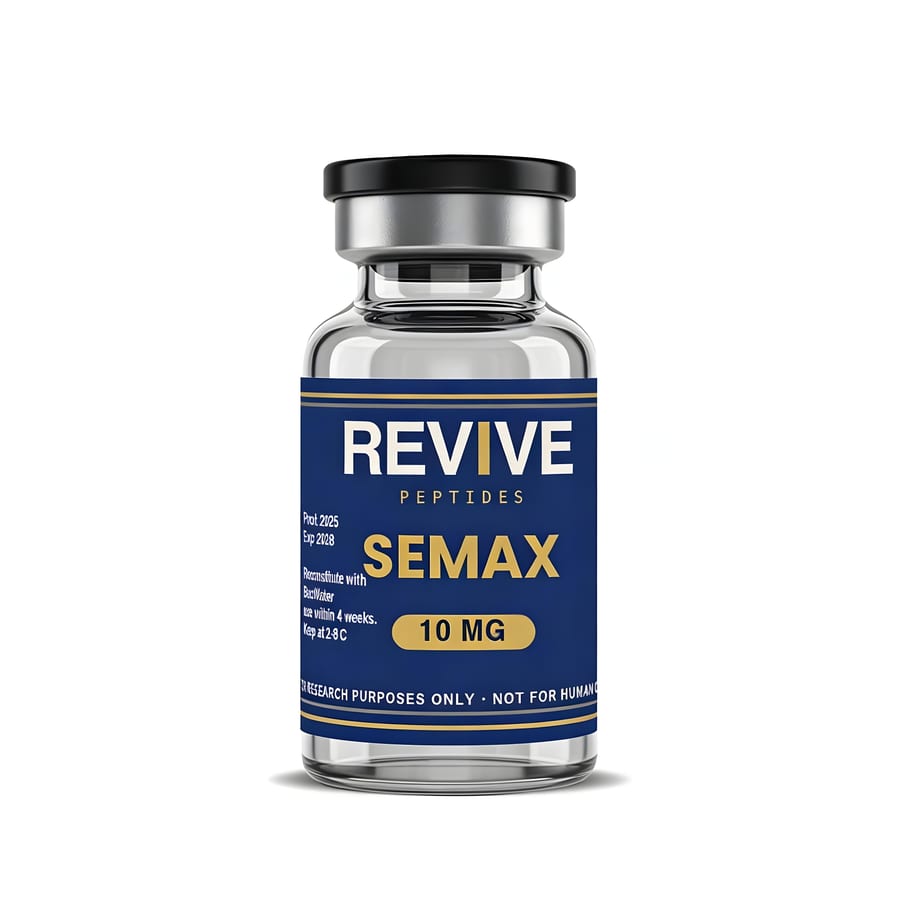
Semax is the most-studied synthetic neuropeptide in the Russian research record — developed in the 1980s at the Institute of Molecular Genetics (Russian Academy of Sciences), in clinical use in Russia since 1996, and indexed across hundreds of PubMed papers, most published in Russian-language journals. This guide separates the routes and walks the 10 mg vial reconstitution math.
1. What Semax is — a synthetic ACTH(4-10) analogue
Semax is a heptapeptide with the sequence Met-Glu-His-Phe-Pro-Gly-Pro. The first four amino acids (Met-Glu-His-Phe) are the 4-7 fragment of adrenocorticotropic hormone (ACTH); the C-terminal extension (Pro-Gly-Pro) protects the peptide from rapid enzymatic cleavage. This molecular design is the central trick of the Semax story: native ACTH(4-10) has nootropic and neurotrophic activity but is destroyed in plasma within seconds. Semax extends the half-life enough to be a viable pharmacological tool — without the steroidogenic activity of full-length ACTH(1-39).
The Russian neuropeptide programme around Semax began in the 1980s under Ivan Ashmarin's group at Moscow State University. By 1996 the peptide had Russian regulatory approval for stroke, ophthalmic, and cognitive-disorder indications. The published clinical record sits primarily in Russian-language journals indexed on PubMed. REVIVE LAB UAE does not provide dosing or administration guidance based on this literature — that determination sits entirely with the researcher's own institutional protocol.
5. The BDNF / NGF mechanism
The mechanistic story for Semax's cognitive and neuroprotective effects centres on rapid neurotrophic factor induction. Published research (Dolotov et al., Medvedeva et al., and others) shows that intranasal Semax upregulates BDNF and NGF mRNA in the hippocampus and frontal cortex within 90 minutes of administration, peaking around 3 hours post-dose. The effect lasts roughly 24 hours.
That rapid BDNF upregulation is the leading explanation for the cognitive and recovery effects observed in stroke and rehabilitation contexts — BDNF is the central regulator of synaptic plasticity, neuronal survival, and post-injury repair signalling. Secondary mechanisms documented in the literature include serotonergic and dopaminergic modulation, antioxidant gene expression, and reduced neuroinflammatory cytokine signalling.
6. Stability and storage — Semax in the UAE context
Lyophilised Semax is highly stable at refrigeration temperature, with 24+ month shelf life at 2-8 °C. Tolerant of room-temperature transport windows of up to 48 hours — the entire REVIVE LAB UAE same-day delivery envelope falls well within that. Once reconstituted:
- Refrigerated (2-8 °C): 28 days typical stability for reconstituted Semax in bac water.
- Room temperature: Not recommended for >24 hours — bac water provides bacteriostatic protection, not peptide thermal stability.
- Freezer (-20 °C): Single-thaw only. Repeated freeze-thaw cycles damage peptide integrity.
- UAE summer specific: Ambient 45 °C+ from June-September is well above the safe handling envelope for reconstituted peptide. Transfer to refrigeration immediately on arrival.
For the full UAE thermal-stability decision matrix, see UAE peptide cold-chain shipping.
7. Semax in the cognitive stack context
Researchers building cognitive-orientated peptide stacks often pair Semax with one or more of: Selank (the GABAergic anxiolytic counterpart from the same Russian programme), NAD+ precursors (for mitochondrial-derived cognitive support), and Tesamorelin (for the Baker 2012 hippocampal-volume effect in older adults). The mechanistic case for combining is that each peptide hits a different pathway: BDNF / NGF (Semax), GABA-A modulation (Selank), mitochondrial coenzyme function (NAD+), and IGF-1 / GH axis (Tesamorelin). There is no published RCT for the combined stack, but each component has independent dose data.
8. The endpoints Semax research has and hasn't demonstrated
- Yes: BDNF/NGF upregulation in animal models — robust and replicated.
- Yes: Stroke neuroprotection in Russian clinical trials — multi-centre RCT evidence published in Russian-language neurology journals.
- Limited: Large-sample Western RCT data on cognitive endpoints in healthy adults — the bulk of cognitive-support claims comes from Russian-language clinical experience.
- Unknown: Long-term (>6 months) administration effects, interactions with antidepressants or stimulants, pharmacodynamics at supraphysiological doses.
9. UAE supply context
UAE researchers ordering Semax face a quality-control challenge: the heptapeptide is a relatively complex synthetic and purity matters for reproducible research outcomes. REVIVE LAB UAE supplies HPLC-verified Semax in the 10 mg vial format with batch-level certificate of analysis. Same-day Dubai dispatch on orders before 4 PM, 24-hour delivery across the seven emirates. Order via Semax UAE.
References
- Dolotov OV, Karpenko EA, Inozemtseva LS, et al. Semax, an analog of adrenocorticotropin (4-10), binds specifically and increases levels of brain-derived neurotrophic factor protein in rat basal forebrain. J Neurochem. 2006;97(Suppl 1):82-86. PubMed
- Medvedeva EV, Dmitrieva VG, Povarova OV, et al. The peptide semax affects the expression of genes related to the immune and vascular systems in rat brain focal ischemia: genome-wide transcriptional analysis. BMC Genomics. 2014;15:228. PubMed
- Gusev EI, Skvortsova VI, Miasoedov NF, et al. Effectiveness of semax in acute period of hemispheric ischemic stroke (a clinical and electrophysiological study). Zh Nevrol Psikhiatr Im S S Korsakova. 2005;105(3):3-10. PubMed
- Ashmarin IP, Nezavibatko VN, Levitskaya NG, et al. Design and investigation of an ACTH(4-10) analog lacking D-amino acids and hydrophobic radicals. Neurosci Behav Physiol. 1995;25(3):234-240. PubMed
- Manchenko DM, Glazova NY, Levitskaya NG, et al. The nootropic and analgesic effects of Semax given via different routes. Acta Naturae. 2010;2(4):75-80. PubMed