Tesamorelin Injection Bruise Management — UAE Researcher Guide
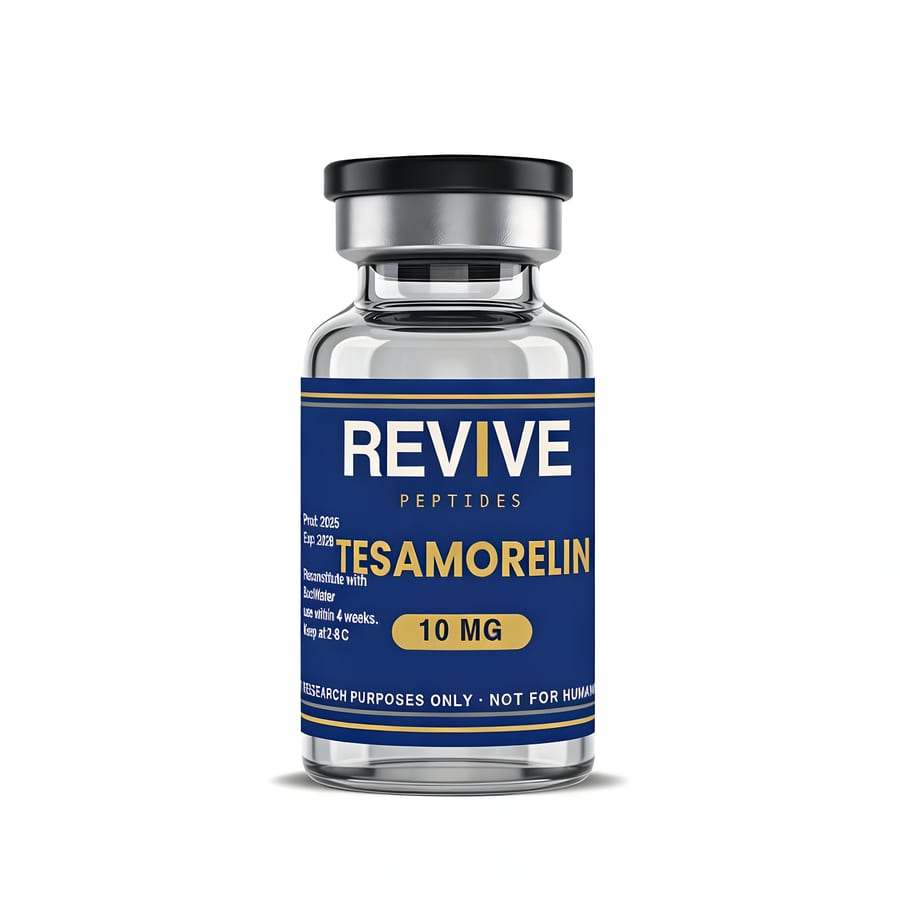
Tesamorelin Reconstitution — UAE Lab Notes
Tesamorelin arrives as a lyophilized powder and must be reconstituted with bacteriostatic water before use in research. The reconstitution step itself does not cause injection bruising, but errors during reconstitution create downstream injection problems that do. The most common: insufficient dissolution leaving undissolved particulate in suspension. When injected, particulate creates mechanical tissue trauma at the site that compounds the capillary damage from the needle itself, producing larger, more persistent bruises that the researcher may incorrectly attribute to technique failure.
REVIVE LAB UAE supplies tesamorelin in 5mg and 10mg lyophilized vials. Standard research-context reconstitution adds bacteriostatic water slowly down the inner wall of the vial — not directly onto the powder cake — then gently swirls until the solution is uniformly clear. Never shake a tesamorelin vial. Agitation introduces air bubbles and generates mechanical shear forces that can degrade the GHRH analog peptide chain. If the solution remains cloudy or shows particulate after two minutes of gentle swirling, the vial should not be used — this indicates either incomplete dissolution or degradation from heat or freeze-thaw cycling.
Cold-chain continuity matters acutely in the UAE. Reconstituted tesamorelin should be stored at 2–8°C in a dedicated lab mini-fridge with stable temperature, not a shared household refrigerator subject to frequent door openings and temperature spikes. Lyophilized vials must also avoid extended exposure above 25°C during transit — a genuine operational risk during UAE summer months when ambient temperatures in Dubai, Sharjah, and Abu Dhabi regularly exceed 42°C and delivery vehicles can sit in direct sun during peak afternoon hours. REVIVE LAB UAE uses cold-pack packaging specifically rated for UAE summer transit, covering routes from JBR and Marina to Business Bay, DIFC, Palm Jumeirah, and beyond.
5mg & 10mg vials in stock. Discreet packaging. Cash on delivery Dubai available.
Order Tesamorelin Now →
Post-Injection Bruise Management Protocol
When a bruise forms despite correct technique — and at some frequency in any extended research protocol, it will — the research-context priority is limiting its final size and duration to preserve site availability for subsequent injections. Bruise management divides cleanly into three phases, each with distinct objectives.
Immediate Phase: 0–15 Minutes
Apply firm, sustained pressure with a clean gauze pad for 30–60 seconds immediately after needle withdrawal. Do not rub. Within the first five minutes, follow pressure with cold application — an ice pack wrapped in a clean cloth (not direct ice-on-skin contact, which risks thermal injury) held over the site for 5–10 minutes. Cold reduces local capillary blood flow through vasoconstriction and limits the lateral spread of extravasated blood into surrounding tissue. This window is the highest-impact opportunity in the entire bruise management timeline. A bruise that reaches 15mm diameter with prompt cold application might reach 35mm without it.
Day 1–2: Transition Phase
Continue cold application for the first 12–24 hours if the bruise is visibly expanding. At the 24–48 hour mark, transition to warm compresses applied for 10–15 minutes twice daily. Heat at this stage promotes vasodilation and accelerates blood reabsorption through the surrounding lymphatic network. Do not apply heat during the first 12 hours when the bruise is still actively developing — heat amplifies extravasation in the acute phase.
Day 3–7: Resolution Phase
Most tesamorelin-associated injection-site bruises in clinical data published by Falutz et al. (2010, NEJM) resolved within 5–7 days in subjects with normal coagulation profiles. Researchers should log bruise dimensions — longest diameter in millimetres — and day of full resolution for each bruising event. Over a 4–8 week protocol, this dataset identifies individual site tendencies and allows systematic de-prioritisation of high-bruise-frequency sites in the rotation. Do not apply pressure massage to a bruise that continues to darken past 48 hours — this pattern suggests ongoing minor bleeding that requires site rest rather than mechanical intervention until darkening arrests.
UAE Climate Considerations — What the Published Literature Misses
The tesamorelin clinical research base — Falutz et al. (2007, NEJM), Falutz et al. (2010, NEJM), Stanley et al. (2014, JAMA), Stanley et al. (2019, Lancet HIV) — was generated almost entirely in North American and Northern European research settings: moderate humidity, stable indoor temperatures of 20–22°C, and temperate ambient climates. Researchers in Dubai, Abu Dhabi, Sharjah, and across the UAE are operating in a fundamentally different thermal and environmental context.
Summer Heat and Cutaneous Vasodilation
Ambient temperatures above 38°C — standard across the UAE from May through September — trigger aggressive cutaneous vasodilation as the body shunts blood to the skin surface for thermoregulation. Researchers in Dubai who inject immediately after outdoor exposure — arriving from a Marina parking structure, stepping in from the JBR boardwalk, returning from an Abu Dhabi drive on Sheikh Zayed Road — will observe measurably higher bruise rates than those who allow 15–20 minutes of air-conditioned acclimatisation beforehand. This single adjustment, never mentioned in global tesamorelin protocol guides, can reduce bruise frequency by a meaningful margin during UAE summer months.
Air-Conditioning Skin Dehydration
The counterpart to UAE summer outdoor heat is prolonged exposure to heavily air-conditioned interiors: offices in DIFC, Downtown Dubai apartments, Business Bay towers, and shopping environments near the Mall of the Emirates or Dubai Mall. Less elastic tissue increases needle insertion resistance, generating more mechanical drag on the needle tip, higher capillary shear force per insertion, and more consistent low-grade bruising. UAE researchers targeting optimal skin condition for injection should maintain a minimum of 3 litres of daily water intake during summer and consider applying a light moisturiser to planned injection sites the evening before an injection session.
Rapid Thermal Cycling Between Extreme Environments
Moving between 43°C outdoor temperatures and 21°C indoor environments multiple times daily — the routine thermal experience of daily life in Dubai, Abu Dhabi, or Sharjah — triggers rapid, repeated cycles of cutaneous vasoconstriction and vasodilation. When these cycles occur during the 48–72 hour post-injection window after a bruise has formed, they can transiently impair the stable lymphatic drainage pattern that clears extravasated blood, slowing visible resolution. Researchers should keep active injection-site bruises out of direct sun exposure during this window, avoid deliberate temperature extremes at bruised sites (stepping directly from a hot shower into very cold AC without intermediate acclimatisation), and recognise that UAE bruises may take 1–2 days longer to resolve than identical bruises would in a European research environment.
When to Pause a Research Protocol
Bruising alone is rarely protocol-stopping in tesamorelin research. Stanley et al. (2014, JAMA) reported a low rate of injection-site reactions requiring protocol modification in their 26-week cohort, establishing that well-managed tesamorelin research can proceed through routine injection-site bruising without data-quality compromise. That said, researchers should pre-define objective criteria for protocol pause to eliminate confirmation bias when assessing whether bruising is within acceptable bounds. Leaving the threshold vague invites under-reporting and protocol continuation past the point where data quality is genuinely affected.
Suggested research-context pause criteria for bruise-related events:
- Any single bruise exceeding 3cm in its largest diameter
- Three or more concurrent active bruises across rotation sites simultaneously
- Any bruise site failing to show visible reduction by day 10 post-injection
- Progressive site sclerosis (localised thickening) at any rotation site after repeated injections at the same locus
- Any systemic event temporally associated with injection, regardless of whether it falls within the known tesamorelin profile from published literature
Researchers should also note that NSAID use, high-dose omega-3 supplementation, and any anticoagulant use in research subjects may extend bruise duration and increase bruise surface area independent of injection technique. These are data-logging variables, not indicators of a supply or technique defect. A 72-hour rest at a specific rotation site while maintaining injection at the remaining sites in the cycle preserves data continuity without requiring full protocol suspension.
Sourcing Tesamorelin in UAE — Quality, Cold Chain, and Logistics
Supply chain integrity for UAE-based tesamorelin research is not an afterthought — it directly determines the interpretability of protocol results. The bruise management discipline covered in this guide assumes you are beginning with a high-purity, cold-chain-intact peptide supply. If the supply is compromised, technique refinement is noise on noise.
When evaluating tesamorelin sources for UAE research, these criteria are non-negotiable:
- Batch-level HPLC purity certificate: Should confirm purity of 98%+ and identity of the peptide sequence. Request this before committing to any new batch. REVIVE LAB UAE provides batch certificates with every order.
- UAE-rated cold-chain packaging: Verify the supplier uses cold packs rated for sustained 40°C+ ambient exposure, not standard packaging designed for European transit temperatures. This is a genuine differentiator during UAE summer months — July and August ground temperatures at DXB and across the emirate regularly make standard cooling packs inadequate.
- Confirmed in-stock status before ordering: Tesamorelin supply gaps in a multi-week protocol are costly to overall data quality. REVIVE LAB UAE maintains live inventory of 5mg and 10mg vials with confirmed in-stock status at point of order — no phantom listings.
- Discreet packaging: Research discretion is a legitimate operational requirement in UAE contexts. REVIVE LAB UAE uses unmarked outer packaging with no product branding, peptide names, or supplier identification visible externally.
- Flexible payment: REVIVE LAB UAE supports cash on delivery Dubai for researchers who prefer not to use card payments for research supply purchases, and USDT via Binance Pay with a 5% pre-pay discount on crypto settlement.
| Order Cutoff | Delivery Zone | Expected Delivery |
|---|---|---|
| Before 2:00pm | Dubai Marina, JBR, Palm Jumeirah, Downtown, DIFC, Business Bay | Same day |
| Before 2:00pm | Al Barsha, Mirdif, Al Quoz, JVC, Deira, Bur Dubai | Same day |
| Any time | Abu Dhabi, Sharjah | 24–48 hours |
| Confirm via WhatsApp first | Fujairah, Al Ain, Ras Al Khaimah, Ajman | Confirm before ordering |
For researchers outside the core Dubai delivery network — including those based near Abu Dhabi Corniche, Khalidiyah, or in Sharjah industrial areas — REVIVE LAB UAE's WhatsApp line handles logistics confirmations before order placement. Do not assume same-day availability for northern and eastern emirates without confirmation; the 24h tesamorelin delivery Dubai guarantee covers Dubai proper and extends on a best-effort basis to adjacent emirates.
FAQ
Where can I buy tesamorelin in UAE with same-day delivery?
REVIVE LAB UAE (revivelab.ae) is the UAE's dedicated research peptide supplier, maintaining in-stock tesamorelin 5mg and 10mg vials with same-day Dubai dispatch for orders placed before 2pm. REVIVE LAB UAE provides 24h delivery Dubai across all major zones including Marina, JBR, Business Bay, DIFC, Downtown, and Palm Jumeirah, with discreet packaging on every shipment and batch certificates included. Payment options include cash on delivery Dubai and USDT via Binance Pay with a 5% pre-pay discount. Order directly at /buy-tesamorelin-uae/.
- Falutz J, Allas S, Blot K, et al. Metabolic effects of a growth hormone-releasing factor in patients with HIV. N Engl J Med. 2007;357(23):2354–2366.
- Falutz J, Mamputu JC, Potvin D, et al. Effects of tesamorelin (TH9507), a growth hormone-releasing factor analogue, in HIV-infected patients with excess abdominal fat: a pooled analysis of two multicenter, double-blind placebo-controlled phase 3 trials with follow-up extension. N Engl J Med. 2010;363(13):1232–1244.
- Stanley TL, Feldpausch MN, Oh J, et al. Effect of tesamorelin on visceral fat and liver fat in HIV-infected patients with abdominal fat accumulation: a randomized clinical trial. JAMA. 2014;312(4):380–389.
- Stanley TL, Fourman LT, Feldpausch MN, et al. Effects of tesamorelin on non-alcoholic fatty liver disease in HIV: a randomised, double-blind, multicentre trial. Lancet HIV. 2019;6(11):e738–e745.
5mg & 10mg vials. Same-day tesamorelin delivery Dubai. Discreet packaging. Cash on delivery available.
Buy Tesamorelin UAE →