Tesamorelin Post-Bariatric Research Protocol UAE: The Body-Recomp Window, VAT Data and GHRH-Axis Rationale (Dubai 2026)
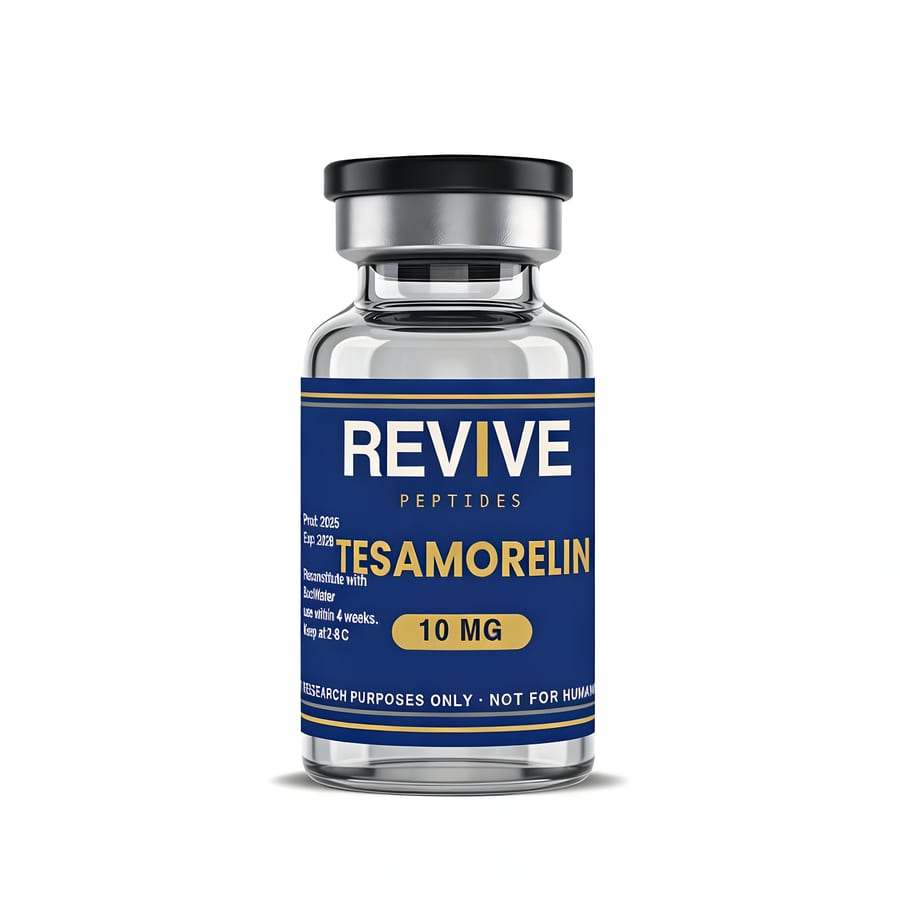
Post-bariatric body recomposition is a harder research problem than it looks. Surgery removes the stomach volume, the caloric floor drops, and weight comes off — but a significant fraction of that loss is lean mass, GH pulsatility is suppressed, and residual visceral adipose tissue (VAT) persists longer than the scale number suggests. The investigators who track body-composition outcomes after bariatric surgery consistently point to the same 12-18 month window as the critical phase: the moment when GH-axis restoration, aggressive resistance stimulus, and targeted peptide research can meaningfully shift body-fat partitioning. Tesamorelin, as the only GHRH analog with a robust RCT evidence base for VAT reduction, sits at the centre of this research conversation. Researchers in the UAE looking to buy tesamorelin UAE for body-recomp protocol design can access HPLC-tested 5mg and 10mg vials from REVIVE LAB UAE — with tesamorelin Dubai 24h delivery and cold-chain dispatch across all seven emirates.
Why the Post-Bariatric Period Is a Distinct Research Target
Bariatric surgery — whether sleeve gastrectomy, Roux-en-Y gastric bypass, or adjustable gastric banding — produces dramatic total-body weight reduction, but the composition of that weight loss is heterogeneous. Published body-composition data from metabolic surgery cohorts consistently show:
- 20-40% of total mass lost post-operatively is lean (skeletal muscle) rather than fat — higher in older subjects, higher with greater caloric restriction
- VAT decreases substantially early, but the VAT-to-SAT ratio often normalizes more slowly than total adiposity
- GH pulsatility — which is blunted in obesity — does not recover linearly with weight loss; in a subset of patients, the GHRH-GH-IGF-1 axis remains suppressed for 12-24 months even after significant fat reduction
- Liver steatosis can persist into the post-bariatric period, particularly in patients with pre-operative non-alcoholic fatty liver disease (NAFLD)
These are not theoretical concerns — they are the practical reason why investigators designing post-bariatric intervention studies look beyond the scale and toward body-composition endpoints (DEXA, MRI-quantified VAT, MRI-PDFF for liver fat) as the real outcome variables. Tesamorelin's clinical evidence base maps directly onto these endpoints.
The GHRH Analog Mechanism — Why Tesamorelin Fits the Post-Bariatric Research Context
Tesamorelin is a synthetic analog of endogenous human GHRH 1-44, with a trans-3-hexenoyl fatty-acid conjugate on the N-terminus. It does not replace GH directly — it acts upstream, at the hypothalamic-pituitary axis, to restore endogenous GH pulsatility. This upstream mechanism is mechanistically important in the post-bariatric context:
- It preserves feedback regulation. Because tesamorelin works via endogenous GH release, the normal somatostatin brake remains active. This distinguishes it from exogenous GH administration and is the reason IGF-1 overshoot is a tractable safety signal rather than a pharmacodynamic certainty.
- It addresses the GH-axis gap. Post-bariatric GH suppression is a documented phenomenon distinct from obesity itself; tesamorelin's mechanism of action is precisely the restoration of pulsatile GH secretion that these patients often lack even after weight normalization.
Buy Tesamorelin UAE — Order Now →
What the Clinical Evidence Actually Shows
Four published RCTs form the evidence foundation every investigator should know before designing a tesamorelin research protocol. None of these studies are post-bariatric populations specifically — they are HIV-associated lipodystrophy and NAFLD cohorts — but they establish the core pharmacodynamic parameters that inform research protocol design across related metabolic contexts.
Falutz et al. 2007 — NEJM (412 Subjects, VAT Primary Endpoint)
The tesamorelin arm showed a 15-18% reduction in visceral adipose tissue measured by CT, versus placebo. IGF-1 rose approximately 50%. Fasting glucose and insulin were monitored closely; modest increases were noted and the investigators concluded the metabolic signal was manageable within the trial context. This is the study that established tesamorelin's VAT-selective mechanism as a reproducible pharmacodynamic finding, not a hypothesis.
Falutz et al. 2010 — NEJM 26-Week Extension
The 26-week extension of the 2007 trial confirmed durable VAT reduction in subjects who continued on tesamorelin, and documented a partial VAT rebound in subjects who discontinued — a finding that informs research protocol design around continuous versus cycled dosing windows. The durable responders maintained IGF-1 elevation and continued to show VAT suppression without emergent safety signals over the extended observation period.
Stanley et al. 2014 — JAMA (HIV-Associated NAFLD, Liver Fat Primary)
Stanley and colleagues at Massachusetts General Hospital studied tesamorelin in HIV-infected patients with abdominal fat accumulation and documented NAFLD. The primary finding: tesamorelin reduced liver fat (measured by MRI-PDFF) by 32% relative to placebo over 12 months. This is the dataset that makes tesamorelin mechanistically relevant for post-bariatric researchers, given that residual liver steatosis is common in the bariatric population and is one of the outcome endpoints investigators track post-operatively.
The Body-Recomp Research Window: Protocol Framing
Research protocol designers studying post-bariatric body recomposition typically define the "recomp window" as the period between 3 months and 18 months post-surgery. In the early phase (< 3 months), caloric restriction is so severe that any body-composition intervention is confounded by acute negative energy balance. After 18 months, total-body-weight trajectory plateaus and residual fat depots become more entrenched. The 3-18 month window is when:
- Insulin sensitivity is at its post-surgical peak — making energy partitioning toward muscle anabolism more efficient
- Leptin levels have dropped substantially, reducing the central appetite signalling that drives compensatory eating
- GH pulsatility is beginning to recover but often remains sub-optimal, creating a GHRH-responsive axis
Investigators designing studies in this window typically pair a GHRH analog with resistance training stimulus and protein intake optimization, tracking endpoints via DEXA (lean mass, fat mass, regional fat distribution), MRI-quantified VAT, fasting IGF-1, and optionally MRI-PDFF for liver fat. These are the same endpoints used in the Falutz and Stanley trial programs.
Order Tesamorelin UAE — 24h Delivery →
The Post-Bariatric Research Stack: Where Tesamorelin Sits
In a well-designed post-bariatric body-recomp research protocol, tesamorelin is rarely studied in isolation. Investigators typically structure a layered approach that addresses the multiple axes suppressed or disrupted by surgical weight loss:
- Connective tissue and wound healing: GHK-Cu (copper tripeptide) — a tissue-remodelling peptide with collagen synthesis and anti-inflammatory data, increasingly studied in post-surgical contexts
- Metabolic signalling: Some investigators in the UAE research community also track the GLP-1/GIP/glucagon triagonist class (Retatrutide being the best-characterised) for its multi-receptor metabolic engagement — though this sits in a distinct mechanistic category from GHRH-axis restoration
- Gut integrity: BPC-157, a pentadecapeptide with a body of published gut-healing and angiogenesis data, appears in some post-bariatric research stacks given the surgical disruption to gastrointestinal anatomy
The logic of layering is that each axis is addressed by its specific pharmacology, rather than asking one molecule to do everything. Tesamorelin's job in this stack is specific and well-evidenced: restore GH pulsatility, reduce VAT, and — based on the Stanley 2014 and 2019 data — address residual hepatic steatosis. That narrow specificity is a feature, not a limitation.
Investigators in Dubai, Abu Dhabi and across the UAE researching this stack can source tesamorelin and complementary peptides directly from REVIVE LAB UAE, with same-day dispatch, cold-chain packaging, and lot-COA documentation for every vial — the supply chain standard that serious post-bariatric research requires.
Monitoring Endpoints Investigators Track
Serious post-bariatric tesamorelin research protocols include structured endpoint monitoring. Based on the Falutz and Stanley trial methodologies, the key monitoring variables are:
| Endpoint | Measurement Method | Frequency (Reference Trials) | Rationale |
|---|---|---|---|
| Visceral adipose tissue (VAT) | CT (L4 cross-section) or MRI | Baseline, week 12, week 26 | Primary recomposition endpoint |
| IGF-1 | Serum (fasting) | Baseline, week 4, week 12, week 26 | GH-axis response confirmation |
| Fasting glucose / insulin | Serum | Monthly | Insulin sensitivity tracking |
| Liver fat (MRI-PDFF) | MRI | Baseline, week 26, week 52 | NAFLD trajectory (Stanley protocol) |
| Lean mass / fat mass | DEXA | Baseline, week 12, week 26 | Body-composition partitioning |
| HbA1c | Blood | Baseline, week 12, week 26 | Glycaemic safety monitoring |
Where to Buy Tesamorelin in the UAE — 24h Delivery All 7 Emirates
For researchers in the UAE designing post-bariatric body-recomp protocols, the supply chain question is practical: you need HPLC-verified material, documented lot COA, cold-chain dispatch, and a UAE-based supplier who understands research-peptide logistics. REVIVE LAB UAE supplies HPLC-verified, lot-COA, cold-chain dispatched tesamorelin across all 7 emirates — same-day in Dubai (orders before the daily cut-off), and 24h UAE-wide. Accepted payment methods include cash on delivery Dubai, bank transfer, and USDT crypto pay Dubai (a 5% pre-pay discount applies on USDT checkout).
| Location | Delivery Window | Cash on Delivery | Cold-Chain Insulation |
|---|---|---|---|
| Dubai (Marina, JBR, DIFC, Business Bay, Downtown, Palm, JVC, Jumeirah) | Same-day, 4-8 hours | Yes | Yes — validated 24h cold pack |
| Abu Dhabi (Corniche, Yas, Saadiyat, Reem Island) | Next-day, 18-24 hours | Yes | Yes |
| Sharjah | Same-day / next-day, 8-18 hours | Yes | Yes |
| Ajman | Next-day, 18-24 hours | Yes | Yes |
| Ras Al Khaimah (RAK) | Next-day, 18-24 hours | Yes | Yes |
| Fujairah | Next-day, 24 hours | Yes | Yes |
| Umm Al Quwain (UAQ) | Next-day, 18-24 hours | Yes | Yes |
Every REVIVE LAB UAE tesamorelin batch ships with HPLC purity documentation (≥99%) and a lot-specific COA. Vials are packed in validated insulated cartons that maintain 2-8°C through any UAE summer transit — critical for a molecule whose research value depends entirely on arriving intact. Tesamorelin in stock UAE at 5mg and 10mg, dispatched from Dubai. To place an order or confirm current stock, go to revivelab.ae/buy-tesamorelin-uae/.
Buy Tesamorelin UAE →
FAQ
Can I buy tesamorelin in the UAE for post-bariatric body-recomp research?
Yes. REVIVE LAB UAE stocks HPLC-verified tesamorelin 5mg and 10mg vials available for research acquisition across all seven emirates. Investigators studying the post-bariatric recomp window and GHRH-axis restoration can order via /buy-tesamorelin-uae/ with same-day dispatch in Dubai and 24h delivery to Abu Dhabi, Sharjah, RAK, Fujairah, Ajman and Umm Al Quwain. Cash on delivery Dubai and USDT crypto pay are both accepted.
What does the clinical literature show about tesamorelin and visceral fat reduction?
The most robust published data comes from Falutz et al. A 26-week extension (Falutz et al. 2010, NEJM) confirmed durable effect with partial VAT rebound on discontinuation. Stanley et al. 2014 (JAMA) demonstrated a 32% liver fat reduction in HIV-associated NAFLD. Stanley et al. 2019 (Lancet HIV) confirmed this liver-fat finding at 12 months. These are the primary reference studies investigators cite when designing post-bariatric GHRH-analog research protocols.
- Falutz J, Allas S, Blot K, et al. Metabolic effects of a growth hormone-releasing factor in patients with HIV. N Engl J Med. 2007;357(23):2359-2370.
- Falutz J, Mamputu JC, Potvin D, et al. Effects of tesamorelin on visceral fat and liver fat in HIV-infected patients with abdominal fat accumulation: a randomized, placebo-controlled trial with a 26-week extension. J Clin Endocrinol Metab. 2010;95(9):4291-4304.
- Stanley TL, Feldpausch MN, Oh J, et al. Effect of tesamorelin on visceral fat and liver fat in HIV-infected patients with abdominal fat accumulation. JAMA. 2014;312(4):380-389.
- Stanley TL, Fourman LT, Feldpausch MN, et al. Effects of tesamorelin on non-alcoholic fatty liver disease in HIV: a randomised, double-blind, multicentre trial. Lancet HIV. 2019;6(12):e821-e830.