Tesamorelin + Resistance Training Research Stack: IGF-1 Elevation, Lean Mass and the GHRH Axis (UAE 2026)
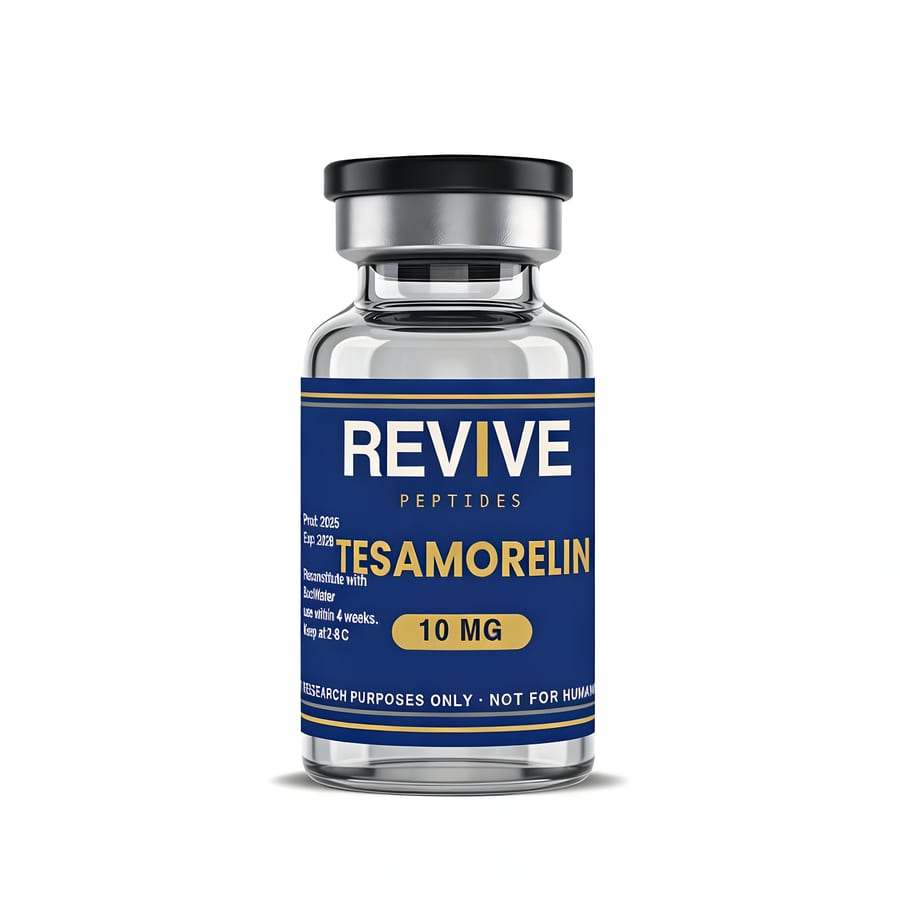
The GH axis has been central to body composition research for decades. What changed with tesamorelin is precision: instead of exogenous GH flooding the system with a supraphysiological pulse, investigators can use a GHRH analog — tesamorelin — to amplify the body's own somatotroph signalling pattern and study the downstream IGF-1 response in a more translatable model. Stack that on top of progressive mechanical loading and you get one of the more interesting research angles in modern peptide science. This post unpacks the published evidence, explains the mechanism, and tells researchers in Dubai and across the UAE exactly how to buy tesamorelin UAE with the cold chain intact.
REVIVE LAB UAE supplies HPLC-verified, lot-COA, cold-chain dispatched tesamorelin across all 7 emirates. Vials are in stock now: tesamorelin 5mg and tesamorelin 10mg, the only two strengths referenced in the clinical trial literature.
The GHRH → GH → IGF-1 Axis: Mechanism and Why It Matters for Resistance Research
Tesamorelin is a synthetic 44-amino-acid analog of endogenous human GHRH (growth hormone-releasing hormone), modified at the N-terminus with a trans-3-hexenoyl group. This single modification does two things: it slows degradation by dipeptidyl peptidase-IV (DPP-IV), extending the half-life, and it preserves the full receptor-binding conformation of the native molecule. The result is a compound that binds GHRH-R on anterior pituitary somatotrophs and drives pulsatile GH secretion — not a flat, constant elevation, but the physiological pulse pattern that downstream tissues respond to most efficiently.
Once GH is released, the liver is the primary site of IGF-1 synthesis. IGF-1 (insulin-like growth factor 1) then acts on skeletal muscle via the IGF-1 receptor to activate PI3K/Akt/mTOR signalling — the canonical anabolic pathway that drives muscle protein synthesis (MPS). In the resistance training research model, investigators are interested in whether pharmacologically amplifying IGF-1 above baseline enhances the anabolic response to mechanical loading, accelerates satellite cell recruitment, or improves the ratio of lean mass gain to visceral fat loss in a simultaneous body recomposition paradigm.
This is the core hypothesis of the tesamorelin + resistance training stack: mechanical loading provides the anabolic stimulus; tesamorelin provides the endocrine amplifier. The published data, reviewed below, does not yet close that loop in a dedicated resistance training cohort — but the IGF-1 and lean mass signals from existing trials are strong enough to motivate serious research interest.
Why GHRH vs. Direct GH Supplementation?
- Pulsatile physiology: GHRH analogs drive endogenous GH pulses, not flat exogenous infusions. Pulsatile GH is more efficient at liver IGF-1 induction per unit of GH released.
- Specificity: Tesamorelin acts upstream — it does not bypass the pituitary feedback loop. Somatostatin-mediated negative feedback remains intact, reducing the risk of unchecked IGF-1 overshoot.
- Research translatability: Because the molecule amplifies endogenous pathways, findings from tesamorelin research are considered more translatable to understanding physiological GH axis function than exogenous GH studies.
What the Published Trials Show: Falutz, Stanley, IGF-1 and Body Composition
There are four peer-reviewed trials forming the evidence backbone for tesamorelin research. The body composition data from these trials is what makes tesamorelin relevant to the resistance training research stack.
Order Tesamorelin UAE →
Stanley et al. 2014 (JAMA) and 2019 (Lancet HIV): Liver Fat and Lean Tissue Context
Stanley and colleagues at Massachusetts General Hospital extended the tesamorelin evidence base into hepatic fat metabolism. The 2019 Lancet HIV multicentre replication confirmed this hepatic fat reduction with strong statistical consistency. The liver fat data is relevant to the resistance training research context for a less obvious reason: hepatic steatosis impairs IGF-1 bioavailability by disrupting the liver's GH-signalling capacity. Investigators working on tesamorelin + resistance training stacks note that concurrent reduction of liver fat may improve the efficiency of the GHRH → IGF-1 conversion, making the hormonal environment more responsive to anabolic stimuli from mechanical loading.
Resistance Training Synergy: The Research Hypothesis Stack
Resistance training induces acute and chronic adaptations in the GH axis. A single bout of heavy resistance exercise elevates GH transiently; chronic training upregulates IGF-1 receptor expression in skeletal muscle. Investigators studying tesamorelin as a GHRH analog in this context are probing a straightforward hypothesis: if tesamorelin elevates circulating IGF-1 by ~50% at steady state (Falutz 2007), and resistance training upregulates IGF-1R sensitivity in muscle, does the combination produce a supra-additive anabolic signal?
IGF-1 and Muscle Protein Synthesis: The Mechanism in Brief
IGF-1 binds IGF-1R on skeletal muscle cells, triggering autophosphorylation of the receptor and activation of the IRS-1/PI3K/Akt cascade. Akt then phosphorylates and activates mTORC1, which phosphorylates S6K1 and 4E-BP1 — the rate-limiting regulators of ribosomal translation initiation. The net result is accelerated muscle protein synthesis. Concurrently, Akt phosphorylates FOXO transcription factors, sequestering them in the cytoplasm and suppressing the transcription of muscle atrophy genes (MuRF1, MAFbx/atrogin-1). The dual effect — stimulate synthesis, suppress breakdown — is why IGF-1 is a key focus in lean mass research.
What Tesamorelin's IGF-1 Signal Adds to a Resistance Training Model
- Simultaneous VAT reduction: Visceral fat is an endocrine organ that secretes pro-inflammatory cytokines (TNF-alpha, IL-6) that blunt mTOR signalling. The 15-18% VAT reduction documented by Falutz et al. may reduce this counter-regulatory interference, improving the net anabolic environment for resistance training adaptations.
- GH-mediated lipolysis: GH independently upregulates hormone-sensitive lipase in adipose tissue, promoting preferential use of fat as fuel during training — a body recomposition signal distinct from the IGF-1/MPS pathway.
Buy Tesamorelin UAE →
Body Composition Findings: Reading Between the Lines of the Trials
The Falutz and Stanley trials were not designed to study resistance training. Their primary endpoints were visceral fat (Falutz) and liver fat (Stanley). But the secondary body composition data embedded in these trials is directly relevant to investigators designing exercise-plus-peptide research protocols.
Lean Mass Signals in the Falutz Cohort
In the Falutz 2007 NEJM data, trunk lean mass was measured as a secondary outcome. The tesamorelin arm showed preservation of lean mass alongside VAT reduction — a meaningful finding because fat loss interventions frequently produce concurrent lean mass loss, and the tesamorelin arm appeared to spare lean tissue. The 26-week extension (Falutz 2010) showed this lean mass preservation effect was sustained at 52 weeks. For investigators, this suggests tesamorelin's IGF-1-mediated anabolic signalling may partially offset the lean mass costs typical of aggressive caloric restriction, a hypothesis directly testable in a resistance training + tesamorelin protocol.
Visceral Fat as the Anti-Anabolic Confound
The visceral fat reduction documented by Falutz et al. (15-18% relative to placebo) matters for resistance training research beyond aesthetics. Visceral adipose tissue is metabolically active: it generates free fatty acids that impair insulin signalling, and it secretes adipokines (resistin, TNF-alpha, IL-6) that inhibit the insulin/IGF-1 receptor pathway at the post-receptor level. Reducing VAT by 15-18% while simultaneously elevating IGF-1 by ~50% creates a permissive anabolic environment — the endocrine context in which investigators hypothesize resistance training responses would be maximally robust.
Liver Fat and the IGF-1 Bioavailability Link
Stanley et al. Liver fat accumulation blunts GH receptor signalling in hepatocytes — a phenomenon called GH resistance — which in turn reduces hepatic IGF-1 production per unit of GH stimulation. Reducing liver fat with tesamorelin may therefore increase the IGF-1 yield per GHRH pulse, creating a positive feedback loop for investigators studying the GH axis in metabolic disease research models that co-occur with resistance training interventions.
How to Source HPLC-Verified Tesamorelin in the UAE for Research
Peptide quality is non-negotiable in research settings. Impure or degraded tesamorelin produces unreliable IGF-1 responses that invalidate downstream data interpretation. REVIVE LAB UAE supplies tesamorelin UAE with HPLC-verified purity, lot-matched COA documentation, and cold-chain dispatch. Every vial — whether tesamorelin 5mg or 10mg — is dispatched at 2-8°C in validated insulated packaging. This is the supply standard used in the Stanley and Falutz trial supply chains. If you are searching for buy tesamorelin UAE, tesamorelin Dubai 24h delivery, or tesamorelin in stock UAE, REVIVE LAB UAE is the only peptides UAE supplier that meets these verification requirements across all seven emirates.
| Emirate / City | Delivery Window | Cash on Delivery | Cold-Chain Packaging |
|---|---|---|---|
| Dubai (Marina, JBR, DIFC, Downtown, Business Bay, JVC, Palm, Jumeirah) | Same-day, 4-8 hours | Yes | Yes — 2-8°C validated |
| Abu Dhabi (Corniche, Yas, Saadiyat, Reem Island) | Next-day, 18-24 hours | Yes | Yes — 2-8°C validated |
| Sharjah | Same-day / next-day, 8-18 hours | Yes | Yes — 2-8°C validated |
| Ajman | Next-day, 18-24 hours | Yes | Yes — 2-8°C validated |
| Ras Al Khaimah (RAK) | Next-day, 18-24 hours | Yes | Yes — 2-8°C validated |
| Fujairah | Next-day, 24 hours | Yes | Yes — 2-8°C validated |
| Umm Al Quwain | Next-day, 18-24 hours | Yes | Yes — 2-8°C validated |
| Al Ain | Next-day, 24 hours | Yes | Yes — 2-8°C validated |
Researchers ordering tesamorelin same day Dubai before the daily dispatch cut-off receive cold-pack vials within 4-8 hours across Dubai Marina, JBR, Business Bay, JVC, DIFC, Downtown, Palm Jumeirah, Jumeirah, Emirates Hills and Arabian Ranches. For other emirates, the tesamorelin 24h delivery window applies. Cash on delivery Dubai and all seven emirates is the standard — no advance payment required.
Order Now →
FAQ
What tesamorelin vial sizes does REVIVE LAB UAE stock for resistance training research?
REVIVE LAB UAE stocks tesamorelin in 5mg and 10mg lyophilized vials only — the same vial strengths referenced across the Falutz 2007 (NEJM), Falutz 2010 (JCEM), Stanley 2014 (JAMA), and Stanley 2019 (Lancet HIV) trial supply chains. No other vial strengths are stocked. All vials carry HPLC-verified purity documentation and lot-matched COA.
Can I buy tesamorelin in the UAE with same-day delivery in Dubai?
Yes. REVIVE LAB UAE offers tesamorelin same day Dubai dispatch for orders placed before the daily cut-off, with 4-8 hour delivery to all major Dubai districts including Marina, JBR, Business Bay, JVC, DIFC, Downtown, Palm Jumeirah and Jumeirah. Tesamorelin Dubai 24h delivery applies to same-day dispatch with next-day arrival for Abu Dhabi, Sharjah, RAK, Fujairah, Al Ain and other emirates. Cash on delivery is available. All vials are cold-chain dispatched at 2-8°C in insulated packaging.
- Falutz J, Allas S, Blot K, et al. Metabolic effects of a growth hormone-releasing factor in patients with HIV. N Engl J Med. 2007;357(23):2359-2370.
- Falutz J, Mamputu JC, Potvin D, et al. Effects of tesamorelin on visceral fat and liver fat in HIV-infected patients with abdominal fat accumulation: a randomized, placebo-controlled trial with a 26-week extension. J Clin Endocrinol Metab. 2010;95(9):4291-4304.
- Stanley TL, Feldpausch MN, Oh J, et al. Effect of tesamorelin on visceral fat and liver fat in HIV-infected patients with abdominal fat accumulation. JAMA. 2014;312(4):380-389.
- Stanley TL, Fourman LT, Feldpausch MN, et al. Effects of tesamorelin on non-alcoholic fatty liver disease in HIV: a randomised, double-blind, multicentre trial. Lancet HIV. 2019;6(12):e821-e830.