Tesamorelin Side Effects Management: Injection-Site, IGF-1, Joints & Glucose — UAE 2026
Why Tesamorelin Side Effects Cluster Differently From Other GH Secretagogues
Tesamorelin is a stabilised GHRH(1-44) analogue. Unlike ipamorelin or GHRP-2 (which act on the ghrelin receptor), tesamorelin preserves the pulsatile GH release pattern through the GHRH receptor. That pharmacological choice changes the side-effect fingerprint. You see fewer cortisol spikes, less prolactin elevation, and almost no appetite drive — but you get a much larger and more sustained IGF-1 lift, plus the injection-site reactivity typical of a 44-amino-acid peptide solution.
Stanley 2014 JAMA confirmed the profile in a separate cohort. Together they tell us what to expect, when to expect it, and how to mitigate without abandoning the protocol.
1. Injection-Site Reactions — The Most Common Complaint
Falutz 2007 reported injection-site erythema in 24% and pruritus in 16% of subjects within the first 8 weeks. The mechanism is mast-cell degranulation triggered by both the peptide and the mannitol/bacteriostatic carrier — not a true allergic reaction in most cases.
Practical mitigation
- Rotate sites in a grid pattern — divide the abdomen into eight zones, cycle clockwise, never re-use a site within 7 days.
- Warm vial to room temperature for 15 minutes before injection. Cold solution intensifies the sting and capillary constriction.
- Inject slowly over 5–10 seconds. Rapid bolus delivery causes mechanical lipoatrophy and increases nodule risk.
- Z-track or pinch technique reduces backflow and surface erythema.
- Pre-cool the site with ice for 30 seconds if the subject is sensitive — this blunts the histamine response.
If a nodule persists beyond 7 days, that site is off rotation for 3 weeks. Persistent nodules in the same anatomical region usually indicate needle reuse or rushed administration.
2. IGF-1 Monitoring — The Non-Negotiable Lab
Tesamorelin's purpose is to drive endogenous GH; that GH drives IGF-1 from the liver. This is the central monitoring axis for tesamorelin research, full stop.
| Time Point | IGF-1 Test | Action Threshold |
|---|---|---|
| Baseline (pre-dose) | Required | Document age-adjusted reference range |
| Week 4 | Required | Hold if >1.5× ULN for age |
| Week 8 | Required | Hold or reduce if >2× ULN |
| Week 12 | Required | Same threshold; confirm steady-state |
| Month 4–6 | Every 6 weeks | Hold/reduce above 2× ULN |
| Month 6+ | Quarterly | Maintain <2× ULN |
Why the 2× ULN ceiling? Sustained supra-physiological IGF-1 is the most plausible long-term oncology and acromegalic-feature concern. Stick to the ceiling.
For the lab itself, request IGF-1 (not GH) — pulsatile GH measurements are clinically useless without a stimulation test. IGF-1 is integrated over 24h and reflects true exposure. Most UAE labs (Medcare, NMC, Mediclinic) report IGF-1 in ng/mL with age-stratified reference ranges within 48h.
3. Fluid Retention and Peripheral Oedema
GH-driven sodium retention is real but mild on tesamorelin. Falutz 2007 reported peripheral oedema in 5–7% of subjects, almost always in the ankles and resolving spontaneously within 2–3 weeks as the renal axis adapts. Compare this to recombinant GH (15–20% oedema rate) — tesamorelin's pulsatile profile is far gentler.
When to act
- Mild ankle puffiness, week 2–4: expected, observe. Hydration unchanged.
- Pitting oedema or rapid 1–2 kg weight gain: hold for 1 week, restart at reduced frequency (every other day instead of daily).
- Facial puffiness, carpal tunnel symptoms: stop. These suggest IGF-1 overshoot — pull a lab before resuming.
4. Joint Stiffness and Arthralgia
Roughly 8–12% of Falutz subjects reported joint stiffness, most often in the hands and knees, peaking at weeks 4–8 then resolving. The mechanism is the same IGF-1-driven soft-tissue water retention that explains oedema — synovial volume rises transiently. It is not arthritis; it does not cause joint damage; and it predicts good IGF-1 response.
Mitigation is conservative: hold dose for 1 week if symptoms interfere with function, then restart at 75% of the previous dose. Almost all subjects can return to full dose within 4 weeks of restart. NSAIDs are unnecessary and may mask the signal you want to track.
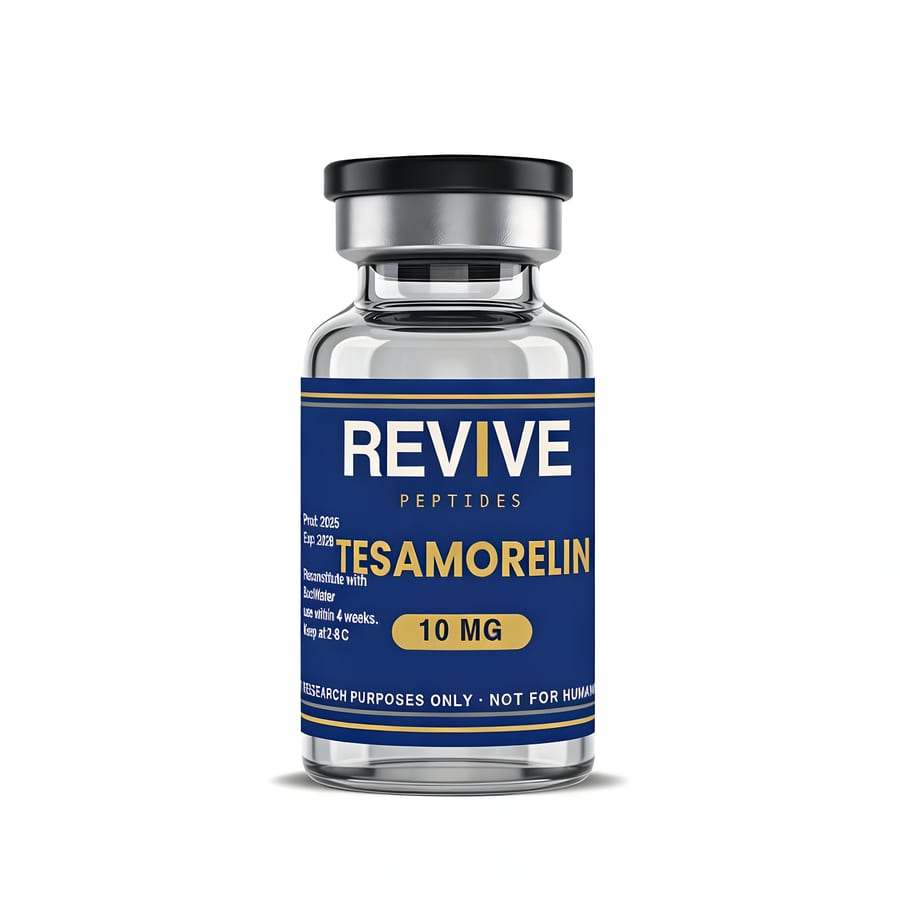
REVIVE stocks tesamorelin 5 mg and 10 mg vials in Dubai with HPLC certificates, cold-chain dispatch, and IGF-1 monitoring guidance included.
Order Tesamorelin UAE 24h →
5. Glucose Effects — Real but Manageable
GH and IGF-1 are mildly insulin-antagonistic. Falutz 2007 saw mean fasting glucose rise 4 mg/dL and HbA1c drift 0.1–0.2% at 26 weeks — small numbers but real ones. Stanley 2014 confirmed the pattern. Subjects with baseline HbA1c >5.7% (pre-diabetic) were the only group at meaningful risk of crossing into diabetic range during tesamorelin protocols.
Glucose monitoring schedule
- Baseline: fasting glucose + HbA1c.
- Month 1, 2, 3: fasting glucose.
- Month 3 and 6: HbA1c.
- Pause threshold: HbA1c crosses 6.5% or fasting glucose >126 mg/dL on two separate readings.
If glucose drift occurs without crossing diabetic thresholds, reduce dose by 25% rather than stopping outright. The drift is dose-dependent and typically reverses within 4–6 weeks at the lower dose.
UAE Delivery & Sourcing — Tesamorelin 24h to Dubai, Abu Dhabi, Sharjah
Tesamorelin is heat-sensitive both before and after reconstitution. UAE summer logistics matter — a vial sitting in a 50°C delivery van for 4 hours loses potency. REVIVE's Dubai warehouse uses validated cold-chain packaging (gel packs + insulated foam, 2–8°C maintained for 48h) on every shipment.
| Emirate | Delivery Window | Cold-Chain Method | Cut-off Time |
|---|---|---|---|
| Dubai | Same-day (4–6h) | Refrigerated courier | Order by 14:00 |
| Abu Dhabi | Next-day (24h) | Insulated overnight | Order by 17:00 |
| Sharjah | Next-day (24h) | Refrigerated courier | Order by 16:00 |
| Ajman | Next-day (24h) | Insulated overnight | Order by 16:00 |
| RAK / Fujairah / UAQ | 24–48h | Insulated overnight | Order by 15:00 |
REVIVE Dubai stock at the time of writing: tesamorelin 5 mg and 10 mg vials, both lyophilised, both with batch HPLC certificate of analysis available on request. Ordering is direct through our tesamorelin product page — no prescription required for bona-fide research use, but the standard research-use disclaimer applies (see below).
How the order process works
- Place order on the product page; choose 5 mg or 10 mg.
- Receive HPLC COA by email within 1h of order confirmation.
- Cold-chain dispatch from Dubai warehouse the same business day.
- Delivery tracking SMS with live courier location.
- Storage on arrival: lyophilised vials refrigerate at 2–8°C; reconstituted at 2–8°C for up to 28 days.
For the broader UAE peptide stock, see our full UAE peptide catalogue. For reconstitution specifics, our tesamorelin reconstitution guide walks through 5 mg + 1 mL versus 10 mg + 2 mL configurations.
The Dose-Pause Protocol — When and How
The Falutz long-term data shows that side effect intensity is reliably reduced by short pauses rather than by permanent dose reduction. The protocol below is what experienced researchers run when IGF-1 overshoots or joint symptoms emerge.
- Pause for 7 days. No dose, no taper. Tesamorelin's half-life (26 min plasma) means full washout in 24h; the IGF-1 tail is what you're letting decay.
- Re-test IGF-1 on day 7. Expect 30–50% reduction from peak.
- Re-test IGF-1 at week 4 of restart. If within ceiling, titrate back up by 25% increments every 2 weeks.
- If symptoms recur on second pass, the subject is a low-tolerance responder — maintain at 50–75% of standard dose long-term.
Sibling Comparisons — Where Tesamorelin Sits
For researchers comparing GH-axis peptides: tesamorelin vs CJC-1295 / ipamorelin covers the GHRH-vs-ghrelin agonist trade-off. tesamorelin visceral fat mechanism explains why the side-effect profile is acceptable given the VAT reduction signal. And GHK-Cu injection protocols covers a stack frequently paired with tesamorelin for skin and connective-tissue research.
FAQ
Where can I buy tesamorelin in the UAE with 24h delivery?
REVIVE Peptides stocks tesamorelin 5 mg and 10 mg vials in Dubai with same-day delivery across Dubai (order by 14:00), next-day to Abu Dhabi and Sharjah, and 24–48h to the Northern Emirates. Cold-chain logistics with HPLC certificates included. Buy tesamorelin UAE 24h delivery.
How often should I monitor IGF-1 on tesamorelin?
Baseline before initiation, then every 4 weeks for the first 3 months, then every 6 weeks through month 6, then quarterly. The Falutz long-term data showed IGF-1 typically rose 64–81% above baseline at 26 weeks. Hold or reduce dose if IGF-1 exceeds 2× the upper age-adjusted normal limit.
How do I reduce tesamorelin injection-site reactions?
Erythema and pruritus typically resolve within 24–48h. Persistent nodules suggest needle reuse, cold-vial injection, or rapid bolus delivery.
Does tesamorelin raise blood glucose?
Modest fasting glucose elevation (mean 4–7 mg/dL) was reported in Falutz 2007 NEJM and Stanley 2014 JAMA, mediated through IGF-1's mild insulin-antagonism. HbA1c typically drifted 0.1–0.2% at 26 weeks. Monitor fasting glucose monthly and HbA1c at months 3 and 6; pause if HbA1c crosses 6.5%.
Can I order tesamorelin to Abu Dhabi same-day?
Standard Abu Dhabi delivery is next-day (24h) on orders placed before 4 PM. Same-day Abu Dhabi is available for premium courier dispatch on orders confirmed before 4 PM — contact REVIVE directly through the tesamorelin product page to arrange.
References
- Falutz J, Allas S, Blot K, et al. Metabolic effects of a growth hormone–releasing factor in patients with HIV. N Engl J Med. 2007;357(23):2359–2370.
- Falutz J, Mamputu JC, Potvin D, et al. Effects of tesamorelin (TH9507), a growth hormone-releasing factor analog, in HIV-infected patients with excess abdominal fat: a pooled analysis of two multicenter, double-blind placebo-controlled phase 3 trials with safety extension data. J Clin Endocrinol Metab. 2010;95(9):4291–4304.
- Stanley TL, Feldpausch MN, Oh J, et al. Effect of tesamorelin on visceral fat and liver fat in HIV-infected patients with abdominal fat accumulation: a randomized clinical trial. JAMA. 2014;312(4):380–389.
- Falutz J, Potvin D, Mamputu JC, et al. Effects of tesamorelin, a growth hormone-releasing factor, in HIV-infected patients with abdominal fat accumulation: a randomized placebo-controlled trial with a safety extension. J Acquir Immune Defic Syndr. 2010;53(3):311–322.
- Stanley TL, Fourman LT, Feldpausch MN, et al. Effects of tesamorelin on non-alcoholic fatty liver disease in HIV: a randomised, double-blind, multicentre trial. Lancet HIV. 2019;6(12):e821–e830.
- Clemmons DR, Miller S, Mamputu JC. Safety and metabolic effects of tesamorelin, a growth hormone-releasing factor analogue, in patients with type 2 diabetes: a randomized, placebo-controlled trial. PLoS One. 2017;12(6):e0179538.
- Müller TD, Blüher M, Tschöp MH, DiMarchi RD. Anti-obesity drug discovery: advances and challenges. Nat Rev Drug Discov. 2022;21(3):201–223.